

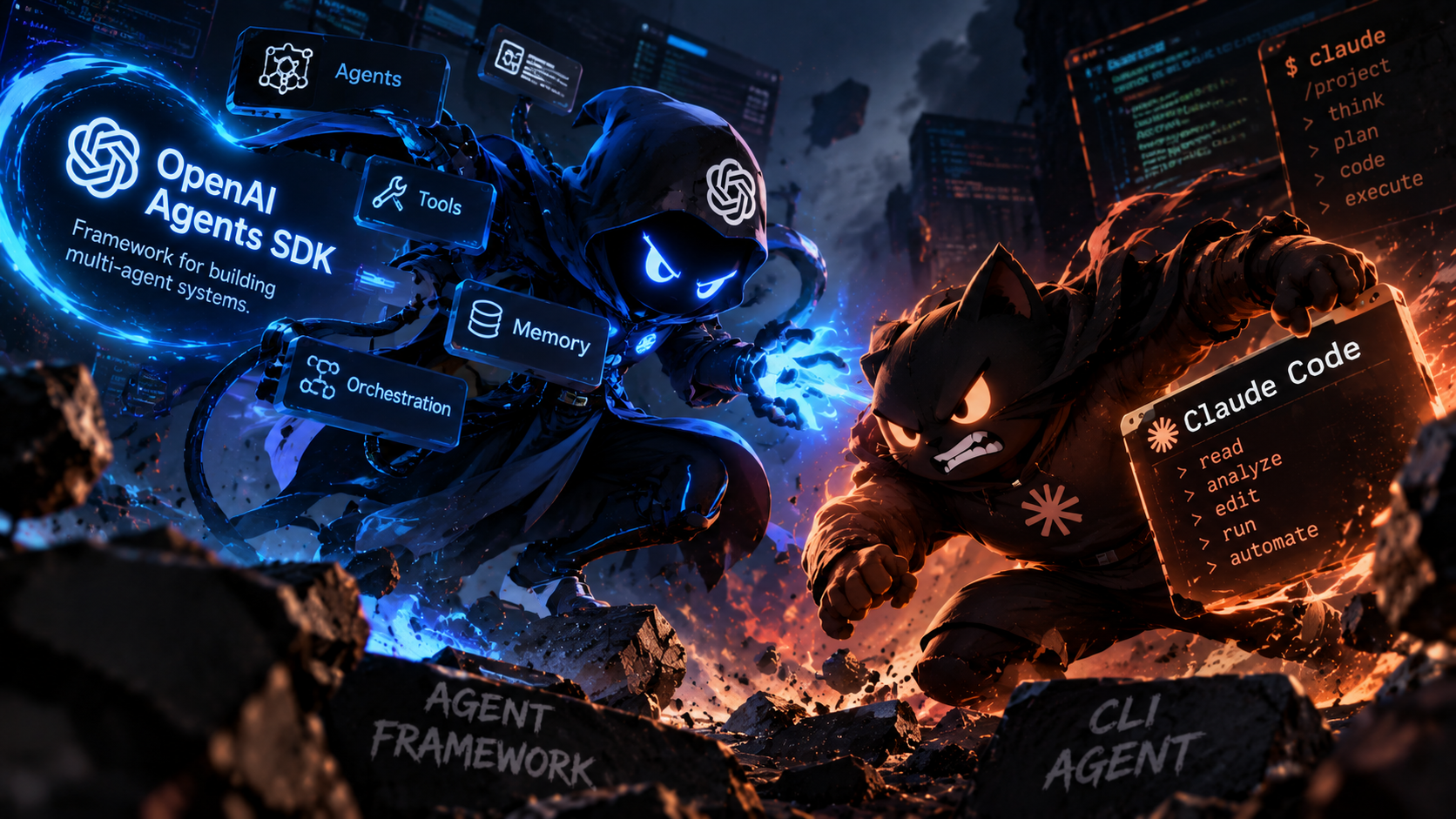
OpenAI Agents SDK vs Claude Code: Which Framework Fits Your Stack
Choosing the Right AI Framework for Your Engineering Stack
When you are building AI applications, picking the right tool can feel overwhelming. I often see development teams struggle to choose between a terminal assistant and a cloud-backed agent library.

OpenAI Agents SDK and Claude Code solve similar engineering problems, but they operate in completely different environments. Where your code runs changes your whole architecture.
Claude Code lives inside your local terminal and repository. It helps you inspect files, run tests, and refactor code directly on your machine.
In contrast, the OpenAI Agents SDK is a backend library. It helps you orchestrate multi-agent workflows, hand off tasks, and run customer-facing web applications.
For a deeper look into terminal workflows, check out building a production AI agent stack.
Core Differences Between Terminal Native Tools and Backend Frameworks
To understand these frameworks, look at where they execute. Code execution location dictates your system design and operational costs.
- Execution Environment: Claude Code runs locally in your shell and file system. OpenAI Agents SDK runs on your backend server via API calls.
- Primary User: Claude Code is built for software engineers working in a local repository. OpenAI Agents SDK is built for backend developers building SaaS products.
- Handoff Model: Claude Code uses sub-agents and local file edits. OpenAI Agents SDK uses explicit Python or TypeScript handoffs between specialized agents.
- Primary Interface: Claude Code is a command-line interface tool. OpenAI Agents SDK is a software library.
Are you building an internal developer tool or an external web app? Which architecture fits your existing codebase best?
While Claude Code gives models direct file system access, OpenAI Agents SDK organizes clean, typed delegation across backend services. Read more in this agent frameworks comparison.
When Claude Code Is the Ideal Choice for Local Codebase Work
Choose Claude Code when your primary goal is active software maintenance or repository refactoring. It operates directly where your code lives, running bash commands and reading local files natively.
Why spend hours building custom file tools when a command-line harness already handles local context? How can terminal integration speed up your engineering workflow?
Claude Code eliminates manual plumbing for developer tools, making it an excellent choice for local engineering. It handles git commits, runs test suites, and fixes bugs without manual copy-pasting.
Learn more about Claude Code vs Claude Agent SDK.
When OpenAI Agents SDK Fits Multi-Agent SaaS Products
The OpenAI Agents SDK shines when building customer-facing SaaS applications, support routing, and multi-tool pipelines. Its handoff pattern allows Agent A to pass structured tasks cleanly to Agent B or Agent C based on strict runtime rules.

Need clear boundaries between user-facing assistants and specialized backend workers? Wondering how to handle multistep customer workflows reliably?
The SDK offers built-in session management, guardrails, and tracing that make cloud deployments straightforward. Explore building multi-agent frameworks for further architectural context.
Architecture and Security Guardrails Across Both Platforms
Security and guardrails differ significantly between local execution and cloud pipelines. Claude Code uses deterministic shell hooks to restrict file edits and block sensitive commands before they run.
Meanwhile, OpenAI Agents SDK uses parallel input, output, and tool guardrails to validate data before passing control.
How do you prevent accidental file modifications in local sessions? What safety checks protect customer data in multi-agent routing?
Both frameworks offer strong controls, but Claude Code focuses on operating system permissions while OpenAI Agents SDK secures API boundaries. Discover how to build secure memory layers in this guide on building multi-tool AI agents with OpenAI Agents SDK and MCP.
Selecting the Best Framework for Your Engineering Stack
Selecting between OpenAI Agents SDK vs Claude Code ultimately depends on your project goals and deployment environment.
If you need an autonomous coding partner inside your terminal, Claude Code is ready to go.
If you are building a SaaS product requiring clean multi-agent delegation and API handoffs, OpenAI Agents SDK is the natural fit.
Which framework aligns best with your delivery roadmap? Can your team combine both tools for different stages of development? Evaluating your execution environment early saves time and keeps your build simple.
Follow Owais Abdullah on Google Search & Discover
Add this domain as a preferred source to see new AI engineering, Next.js SaaS, and Digital FTE breakdowns prioritized in your Google Top Stories, AI Overviews, and Discover feed.

Owais Abdullah
Web & AI Engineer · Founder @ Octively
Spec-driven developer and AI engineer. Founder of Octively, building Next.js SaaS platforms, autonomous Digital FTEs (AI employees), and production-ready intelligent workflows.
Recent Posts




Did you find this article helpful?
Questions I get
Frequently Asked Questions
Discussion & Thoughts
Join the conversation with your perspective