

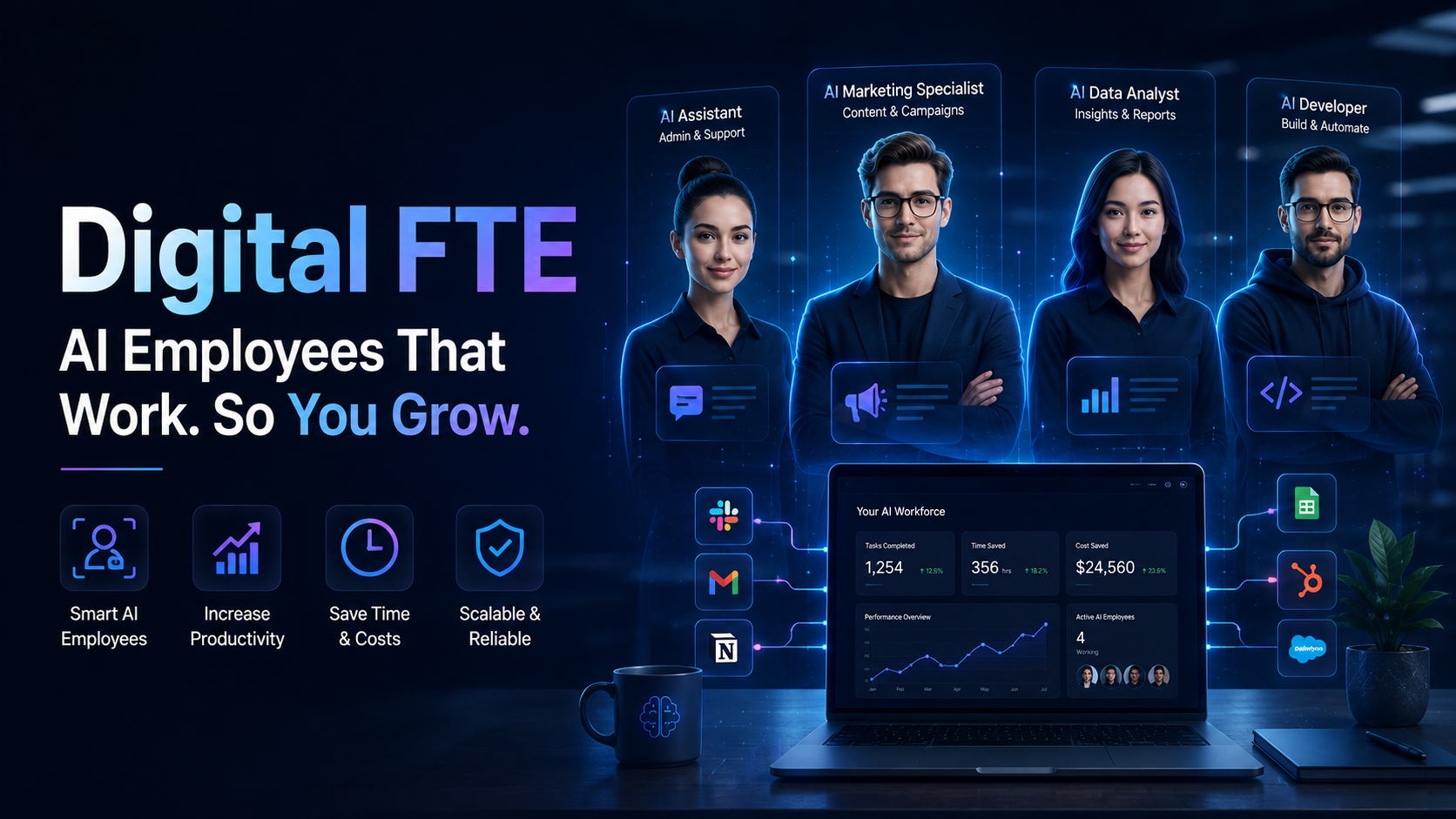
Understanding the Digital FTE and How Smart Virtual Workers Handle End-to-End Tasks
Have you ever wondered how some teams run complex operations around the clock without swelling their payroll? I spent years watching smart founders drown in repetitive daily tasks that drained time away from strategic growth. That is exactly where a Digital FTE comes into play.
Short for Full-Time Equivalent, a Digital FTE is a smart virtual worker built to handle complete job functions continuously. Unlike basic prompt tools or simple chatbots that sit around waiting for explicit commands, a Digital FTE operates independently. It tracks incoming data, carries out multi-step tasks, and delivers concrete business results without manual handholding.
In this guide I'll walk you through what a Digital FTE really is, how it works 24/7, how you measure its value, and how industry leaders are deploying them today. You'll also see why specification-first building is the secret to trusting these autonomous workers. Ready to see how autonomous systems can relieve operational pressure? Explore how custom Digital FTE (AI Employee) Development turns everyday workflows into streamlined systems.
What Is a Digital FTE and How It Differs From Basic Automation
Are you tired of jumping between different apps just to complete one simple process? I get it. Traditional software scripts follow strict, rigid rules and stop whenever something unexpected happens. They break the moment a file is missing or a field is formatted differently.
A Digital FTE acts as an autonomous virtual team member that thinks through multi-step tasks and handles edge cases. Instead of just assisting a person with a single action, it owns the entire job function from start to finish.

The key difference comes down to autonomy and persistence. A teammate doesn't wait for you to wake them up every morning. They are already monitoring the codebase, the inbox, or the queue. As the Synthesis - The Digital FTE Vision explains, the jump from a session-based tool to a Digital FTE is defined by autonomy and persistence.
Here's a simple way to think about the difference:
- A chatbot answers when you ask.
- A tool runs when you trigger it.
- A Digital FTE monitors its domain, identifies needs, and executes on its own.
How much time could your team save if routine monitoring happened automatically? That's the question that made me rethink how I build automation in the first place.
How Autonomous Digital Workers Function 24/7 Across Core Operations
What happens when critical operational events occur outside normal office hours? With a Digital FTE, nothing stalls. Digital workers run continuously, watching your systems, processing records, and executing tasks around the clock.
They combine smart decision engines with connected communication channels to manage incoming requests, flag anomalies, and handle daily administrative routines without fatigue. A human team can't stay alert at 3 a.m., but an autonomous worker can review 10,000 invoices in a month with zero fatigue.
At the technical level, a Digital FTE is built from a few core parts:
- The general model acts as the brain for reasoning and communication.
- MCP and tooling act as the hands, giving direct access to your codebase, databases, or cloud infrastructure.
- Agent skills act as the training, encoding the standard operating procedures and guardrails for the role.
- An autonomous loop acts as the shift, running 24/7 and monitoring triggers without a human start command.
This is the shift from AI as an assistant to AI as a functional owner. How would your operations change if your business never went offline?
Measuring Business Value and Capacity Gains With Digital FTEs
How do you measure productivity when a worker is purely digital? Rather than tracking hours spent sitting at a desk, organizations measure Digital FTEs by total work output and task completion rates.
As Measuring Digital FTE: A New Metric for Business Efficiency highlights, treating digital workers as measurable capacity units gives leaders a clearer picture of workforce planning. This model lets human talent focus on high-judgment, creative tasks.
The numbers are striking. According to Deloitte's analysis of the rise of Digital FTEs, organizations embracing intelligent automation have already achieved the equivalent of 20 to 30 percent of their workforce as Digital FTEs.
Here are a few concrete examples from that research:
- Developers using AI tools report a 40 to 50 percent increase in productivity, with roughly one Digital FTE of output gained for every three developers.
- AI contract review in financial services can save up to 360,000 hours a year, equal to more than 170 legal or compliance FTEs.
- Pre-screening mammograms with AI can save an estimated 500,000 hours a year of radiologist time, equal to 250 to 300 FTEs.
Could measuring digital capacity help you forecast growth more accurately? For most teams I work with, the answer is a clear yes.
How Industry Leaders Deploy Digital Workers for Scalable Operations
Where are top organizations finding the most practical success with virtual workers? Leading companies across tech, finance, and logistics deploy digital workers to streamline high-volume procedures.
In software engineering, Digital FTEs help with real-time code suggestions, automated code reviews, and streamlined testing and deployment. In retail and e-commerce, they automate demand forecasting and stock optimization so planners can focus on customer experience and innovation.
Even high-risk industries like nuclear energy, space exploration, and chemical manufacturing use Digital FTEs to analyze sensor data, detect anomalies, and ensure operational continuity.
What all these deployments share is a focus on outcomes rather than tasks. A Digital FTE doesn't just complete one step. It owns the full job function and delivers a measurable result.
What high-volume bottleneck in your organization is ready for automation? If you're not sure where to start, the Digital FTE (AI Employee) Development service I offer maps repetitive processes to autonomous agents and measures the impact.
How Spec-Driven Building Ensures Reliable Autonomous Agents
Can you trust a digital worker to handle important tasks without breaking things? This is the question every founder asks me, and it's a fair one.
The key to reliable autonomous agents lies in clear, specification-first engineering rather than guesswork. When you define precise standards, guardrails, and structured workflows, digital workers execute tasks predictably every single time.

I've seen what happens when teams skip this step. They prompt an AI, look at the output, adjust, and repeat until something seems right. This vibe coding approach feels productive at first, but each iteration introduces subtle bugs. Nobody knows exactly what the system does, and changes break things in unexpected ways.
Here's the insight that changed how I build: AI is an amplifier. It amplifies your good habits and your bad habits. If you write clear specifications, AI executes them precisely and quickly. If you work from vague ideas, AI generates confident-looking output that's wrong in subtle ways, faster than you can catch the errors.
So before you deploy a Digital FTE, define the acceptance criteria, the edge cases, and the escalation rules. Run it in shadow mode first, where your team sees what the agent would do and validates decisions. Then move to autonomous mode for routine cases with escalation for anything unusual.
How can structured specifications prevent errors in your automated workflows? In my experience, they are the difference between an agent you trust and one you constantly babysit.
Follow Owais Abdullah on Google Search & Discover
Add this domain as a preferred source to see new AI engineering, Next.js SaaS, and Digital FTE breakdowns prioritized in your Google Top Stories, AI Overviews, and Discover feed.

Owais Abdullah
Web & AI Engineer · Founder @ Octively
Spec-driven developer and AI engineer. Founder of Octively, building Next.js SaaS platforms, autonomous Digital FTEs (AI employees), and production-ready intelligent workflows.



Did you find this article helpful?