

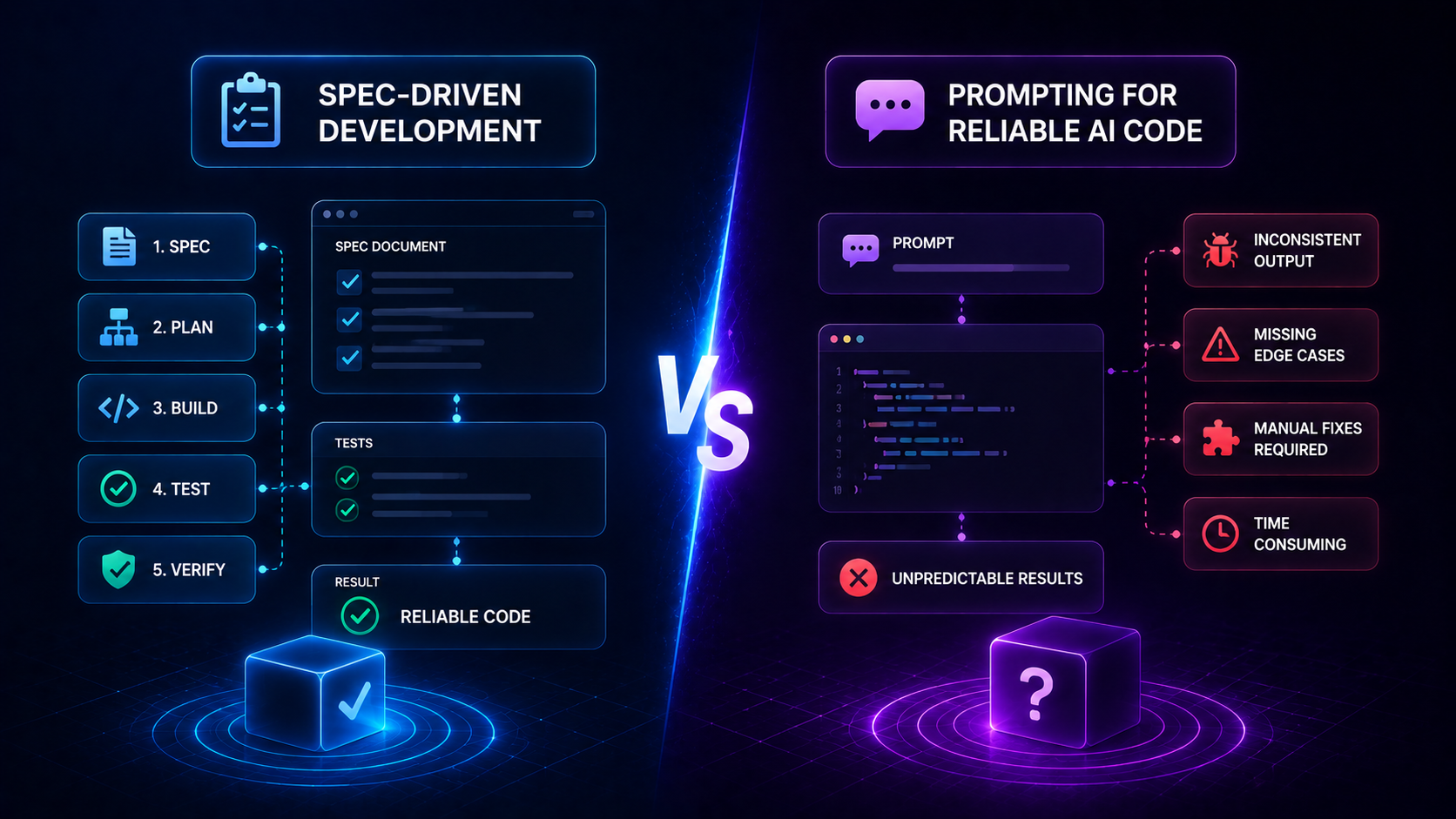
Spec-Driven Development vs Prompting for Reliable AI Code
Why Raw Prompting Fails on Complex Projects
Casual chat prompts are fantastic for quick prototypes, but they fall short on serious applications because language models cannot read your mind. When you skip upfront planning, the agent relies entirely on probabilistic pattern matching to fill in missing requirements. This often results in code that compiles on the first try but solves the wrong problem or violates your team's security standards.
Structuring your instructions into a clear roadmap prevents costly rework. By defining your target behavior early, you ensure the agent builds what you actually need.

- Why do AI coding agents struggle with unstated project requirements?
- How does shifting from casual chat to structured planning improve your final output?
For a deeper dive into structured tooling, check out the GitHub Spec-Driven Development Toolkit. You can also read more about modern system architectures in AI Agents, Automations, and Agentic AI - What’s Really Different?.
Understanding the Core Modalities of Spec-Driven Development
Spec-Driven Development is not a monolith; it operates across different levels of commitment to documentation. Understanding these tiers helps you choose the right approach for your team's workflow and existing codebase.
The three primary modalities include spec-first workflows, spec-anchored systems, and spec-as-source models. In spec-first setups, you write requirements before generating code for a specific task. Spec-anchored workflows retain documentation to guide future feature evolution, while spec-as-source models treat specifications as the primary editable artifact rather than raw source code.
- Which SDD modality works best for fast-paced feature development?
- How do living documentation files keep your team aligned over time?
To explore how experienced architects evaluate these different tooling models, read Martin Fowler's Analysis on Spec-Driven Development Tools.
Breaking Down the Specify, Plan, and Task Workflow
A reliable SDD workflow breaks down your engineering process into deliberate, verifiable phases. Instead of tossing a giant prompt into your chat window, you guide the agent through distinct operational steps.
First, you specify the user experience and functional goals. Next, you establish a technical plan detailing your stack, architecture, and compliance rules. Finally, you generate granular tasks that can be built and tested in isolation. This granular task breakdown turns overwhelming feature requests into manageable, reviewable chunks.
- How do structured task breakdowns prevent agents from hallucinating architecture?
- What is the benefit of separating functional requirements from technical implementation steps?
Weighing the Upfront Friction Against Long-Term Reliability
Introducing specifications and markdown files adds upfront friction to your development cycle. Writing requirements before touching code feels counterintuitive when you are eager to see results.
However, that initial investment pays off when you review focused changes instead of wading through thousands of lines of unverified code. You trade a few minutes of planning time for hours saved in debugging and architectural refactoring.
- Is the extra documentation overhead worth the reduction in debugging time?
- How do you balance speed when building small fixes versus large features?
Best Practices for Adopting SDD in Your Engineering Workflow
Adopting spec-driven workflows does not mean you need to overhaul your entire development process overnight. Start by applying these practices to your next medium-sized feature or legacy modernization task.
Establish a clear memory bank or constitutional rules file that your coding agent references during every session. Encourage your team to treat specifications as living artifacts that evolve alongside your codebase rather than static documents left in a forgotten wiki.
- How can you introduce spec-driven habits without slowing down your team?
- What tools can help automate your specification and task generation cycles?
Follow Owais Abdullah on Google Search & Discover
Add this domain as a preferred source to see new AI engineering, Next.js SaaS, and Digital FTE breakdowns prioritized in your Google Top Stories, AI Overviews, and Discover feed.

Owais Abdullah
Web & AI Engineer · Founder @ Octively
Spec-driven developer and AI engineer. Founder of Octively, building Next.js SaaS platforms, autonomous Digital FTEs (AI employees), and production-ready intelligent workflows.
Recent Posts

Context Memory Systems for Multi Agent AI Workflows: Architecture & Best Practices
Sep 27, 2026
AI Agent Over-Engineering: Simple Workflows vs 30-Agent Architectures
Sep 26, 2026
Stop AI Agent Overengineering and Use Simple Workflows
Sep 25, 2026
Jev System One Model: Cut AI Classifier Latency and Costs
Sep 24, 2026
Did you find this article helpful?
Questions I get
Frequently Asked Questions
Discussion & Thoughts
Join the conversation with your perspective