

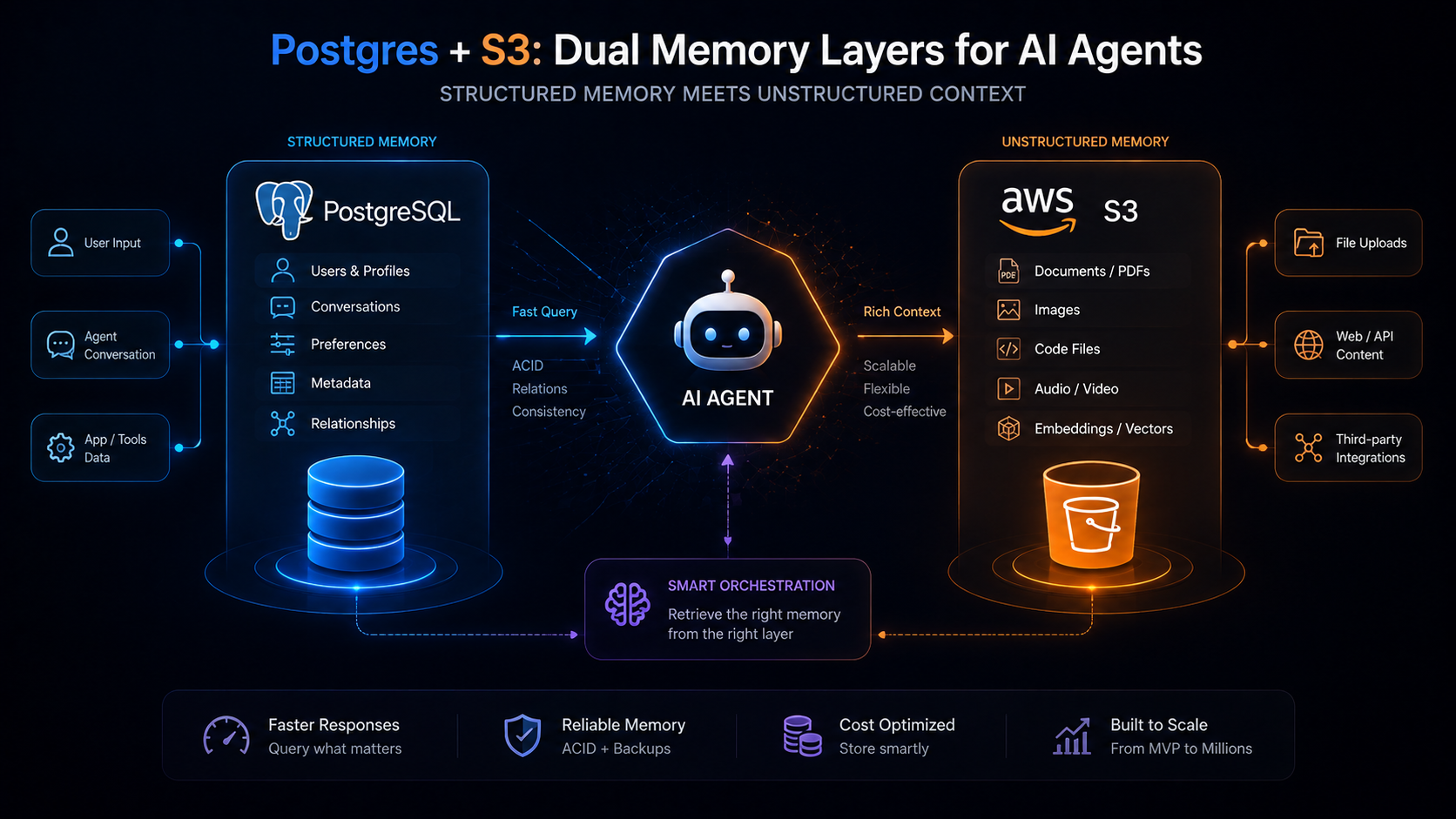
Postgres and S3 Memory Layers for AI Agents
Why Stateless Large Language Models Need Persistent State Layers
Most language models operate without built-in persistence, meaning every API invocation starts from a blank slate. When building production assistants, how do you maintain user preferences and conversation continuity across separate interactions?
Without a dedicated backend, applications experience memory loss upon server restarts or scaling events. Implementing external data layers ensures agents retain episodic history and contextual background safely.
- How can developers prevent conversation amnesia after a server deployment? You can use durable connection savers and persistent database checkpointers rather than in-memory volatile lists. Read more about stateful workflows in AI Agents, Automations, and Agentic AI - What’s Really Different?.
- Why do stateless architectures fail when handling multi-session user interactions? Stateless designs drop context frames the moment an API connection closes, making long-running reasoning loops impossible.
Structuring Episodic and Semantic Memory with PostgreSQL
Relational databases have powered enterprise software for decades, making them a natural fit for structured agent memory. How can you leverage Postgres for both transactional state and vector similarity?

Using extensions like pgvector alongside standard table partitioning allows teams to store chat logs, agent checkpointers, and embeddings in one unified store. This eliminates the operational overhead of managing separate vector databases.
- Can relational tables handle high-volume vector searches efficiently? Yes, indexed vector columns in Postgres match specialized vector engines for mid-scale workloads while keeping relational foreign keys intact.
- What makes Postgres a reliable alternative to specialized vector stores? According to Building AI Agents with Persistent Memory, keeping vectors next to user records reduces network hop latency.
Offloading Bulk Artifacts and Transcripts to AWS S3
While PostgreSQL excels at relational queries and semantic search, storing massive document corpora or raw conversation transcripts in a database quickly degrades performance. When should you rely on object storage?

AWS S3 serves as an ideal deep-storage context layer for binary assets, large knowledge base documents, and bulk transcripts. Streaming these large files directly to object storage keeps your database lean and responsive.
- How do you balance data storage between relational tables and object storage? Keep structured metadata in Postgres and push large raw files to S3 buckets, referencing them via uniform resource identifiers.
- What are the cost implications of keeping raw transcripts in database blobs versus S3? Object storage charges significantly lower per-gigabyte rates for cold and warm archival data than relational block storage.
Implementing Hybrid Search and Context Retrieval Strategies
Fetching relevant memories requires more than simple keyword matching. How do you combine vector similarity with relational filters for precise retrieval?
Engineers can implement hybrid search strategies that merge BM25 keyword scoring with cosine similarity vectors. This ensures agents retrieve logically relevant facts while respecting temporal validity and metadata constraints.
- How does hybrid retrieval outperform pure vector search in production? It filters out semantic false positives by requiring exact keyword matches on critical product IDs or dates.
- What strategies help filter out stale memories during context assembly? As noted by Building a Memory Layer for AI Agents, time-decay weighting prevents outdated facts from poisoning current LLM prompts.
Avoiding Common Memory Architecture Pitfalls
Building agent memory systems comes with distinct engineering challenges, from memory leaks to token budget overflow. How can teams ensure their memory layers scale smoothly?
Common anti-patterns include using in-memory savers in production or failing to compress historical conversation logs. Establishing proper memory decay and summarization workflows keeps inference costs under control.
- Why do development-only memory savers break production deployments? Volatile savers clear all state on every container restart, instantly erasing user chat history.
- How can developers prevent context window bloat during long agent runs? You can summarize older chat turns into concise episodic summaries before appending them to the active prompt context.
Follow Owais Abdullah on Google Search & Discover
Add this domain as a preferred source to see new AI engineering, Next.js SaaS, and Digital FTE breakdowns prioritized in your Google Top Stories, AI Overviews, and Discover feed.

Owais Abdullah
Web & AI Engineer · Founder @ Octively
Spec-driven developer and AI engineer. Founder of Octively, building Next.js SaaS platforms, autonomous Digital FTEs (AI employees), and production-ready intelligent workflows.
Recent Posts

Context Memory Systems for Multi Agent AI Workflows: Architecture & Best Practices
Sep 27, 2026
AI Agent Over-Engineering: Simple Workflows vs 30-Agent Architectures
Sep 26, 2026
Stop AI Agent Overengineering and Use Simple Workflows
Sep 25, 2026
Jev System One Model: Cut AI Classifier Latency and Costs
Sep 24, 2026
Did you find this article helpful?
Questions I get
Frequently Asked Questions
Discussion & Thoughts
Join the conversation with your perspective