

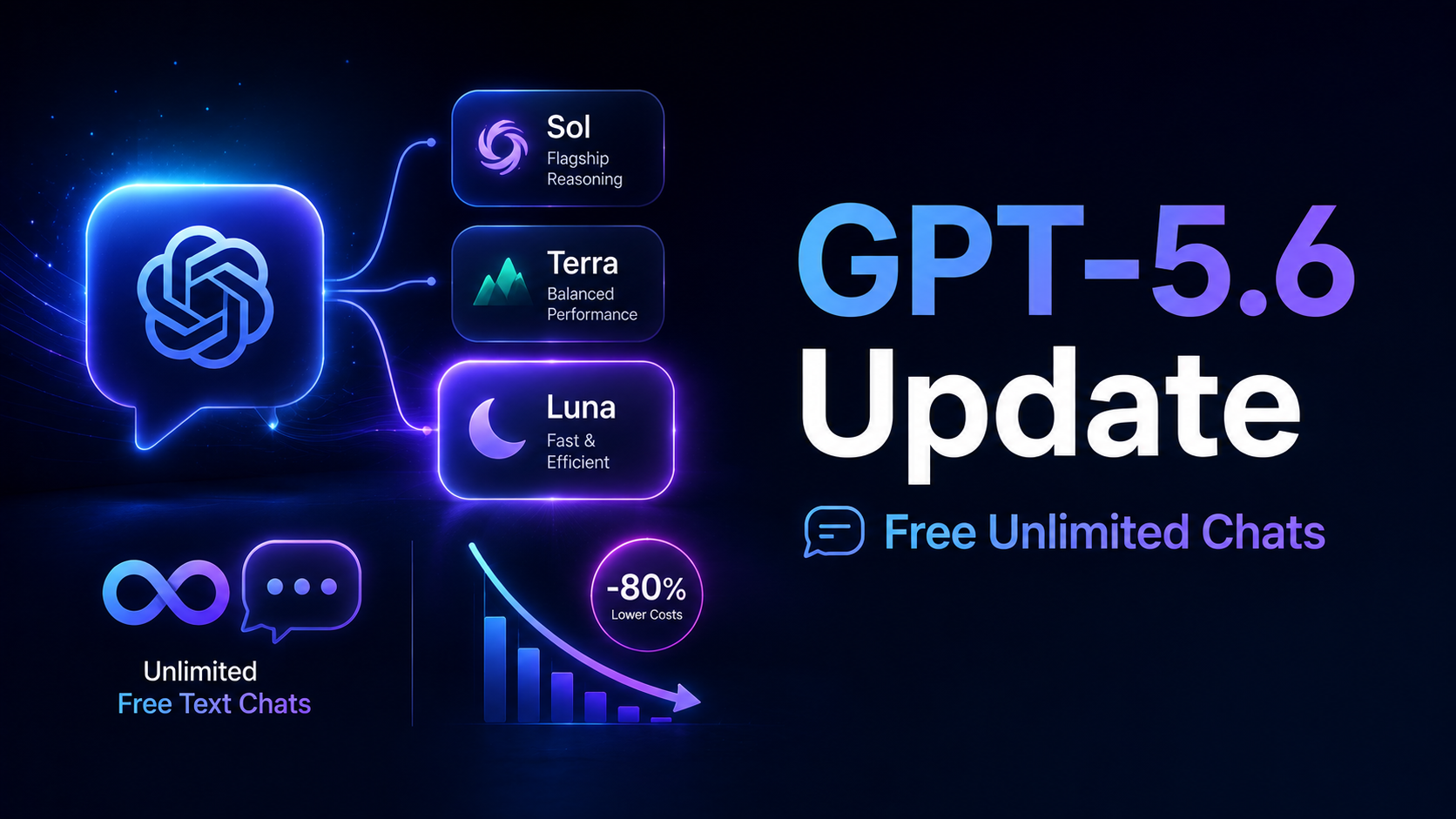
OpenAI ChatGPT Update: GPT-5.6 Luna, Free Unlimited Chats & Price Cuts
Artificial intelligence pricing and accessibility are shifting rapidly. With the rollout of the GPT-5.6 model family, OpenAI has introduced free unlimited text chats using the efficient GPT-5.6 Luna model, alongside significant cost reductions for developers and creators. This aggressive move is a direct response to intensifying competition from Anthropic's Claude and from Chinese frontier models like DeepSeek, GLM, Qwen, and Kimi offering cheap, high-quality AI. OpenAI's Codex plan is a cost-effective option for developers who mainly need planning support rather than full execution.
These rivals have been rapidly chipping away at market share by offering cutting-edge intelligence at a fraction of traditional costs, forcing OpenAI to slash prices and expand free access specifically to stay ahead and protect its market position. If you build web experiences, manage automated workflows, or rely on AI every day, understanding these model updates helps you optimize your operational costs. When evaluating these changes, you might want to learn more about AI & AI Agents to streamline your daily routines.
What is the GPT-5.6 Luna Release
The introduction of GPT-5.6 Luna brings faster, highly cost-effective smart automation to free tier users without text-chat limits. Driven directly by the competitive pressure of low-cost alternatives, OpenAI has slashed prices for Luna by 80% and Terra by 20%, making high-performance AI more accessible as users increasingly defect to cheaper frontier offerings.
- Are you noticing faster response times on your free tier chats?
- How will lower API costs change your approach to building web applications?
Read more details in the official OpenAI GPT-5.6 Announcement.
Exploring Free Unlimited Text Chats on ChatGPT
Free and Go users now get access to the efficient GPT-5.6 Luna model with text chat limits removed, a feature rollout heavily influenced by the generous free tiers and aggressive pricing models offered by competing chatbots like Claude and DeepSeek. This update makes casual querying, rapid prototyping, and everyday research much smoother without requiring an immediate upgrade to a paid plan.
- Have you checked your chat interface for the new model label?
- What tasks will you test first on the expanded free tier?
Check out the OpenAI ChatGPT Release Notes for a complete breakdown of version changes.
How Price Reductions Impact API Developers and Builders
For builders and creators integrating AI into apps, an 80% price reduction on GPT-5.6 Luna changes the math, directly addressing the developer exodus toward ultra-cheap API offerings from providers like DeepSeek and GLM. Lower token costs mean you can run sub-agents and automated pipelines more frequently while keeping overhead minimal under this new competitive pricing regime.
- Which workflows will benefit most from lower model pricing?
- Are you planning to migrate your existing scripts to the new API pricing tiers?
Review the OpenAI API Pricing Guide to calculate your potential savings.
Balancing Performance and Cost with Sol, Terra, and Luna
The GPT-5.6 family offers distinct tiers: Sol for flagship reasoning, Terra for balanced everyday work, and Luna for maximum efficiency. To counter Anthropic's efficiency gains and the specialized reasoning of models like Kimi K3, OpenAI has carefully segmented these tiers.
When stacking GPT-5.6 Luna up against Claude and leading Chinese models (e.g. DeepSeek, Kimi, GLM), OpenAI's new pricing and access structure directly addresses the gap: Luna matches the affordability and high-speed availability of low-cost Chinese alternatives while maintaining robust ecosystem integration. Choosing the right model for specific sub-tasks keeps your tech stack lean and responsive against these competitive benchmarks.
- When should you switch from a flagship model to a cost-efficient tier?
- How does your project handle task complexity versus token expenditure?
Consult benchmarks on the Artificial Analysis Intelligence Index to compare performance metrics.
Maintaining Data Privacy with Zero Data Retention Routing
As teams scale their AI usage, data privacy becomes paramount—especially as organizations weigh the security compliance of US models against emerging international options. Utilizing zero data retention routing and end-to-end encryption ensures client information stays secure while leveraging frontier model capabilities via API compatibility.
- What privacy measures do you currently enforce in your automation workflows?
- How do you evaluate data security when integrating third-party AI models?
Learn more about standards through OpenAI Security and Privacy documentation.
Follow Owais Abdullah on Google Search & Discover
Add this domain as a preferred source to see new AI engineering, Next.js SaaS, and Digital FTE breakdowns prioritized in your Google Top Stories, AI Overviews, and Discover feed.

Owais Abdullah
Web & AI Engineer · Founder @ Octively
Spec-driven developer and AI engineer. Founder of Octively, building Next.js SaaS platforms, autonomous Digital FTEs (AI employees), and production-ready intelligent workflows.




Did you find this article helpful?
Questions I get
Frequently Asked Questions
Discussion & Thoughts
Join the conversation with your perspective