

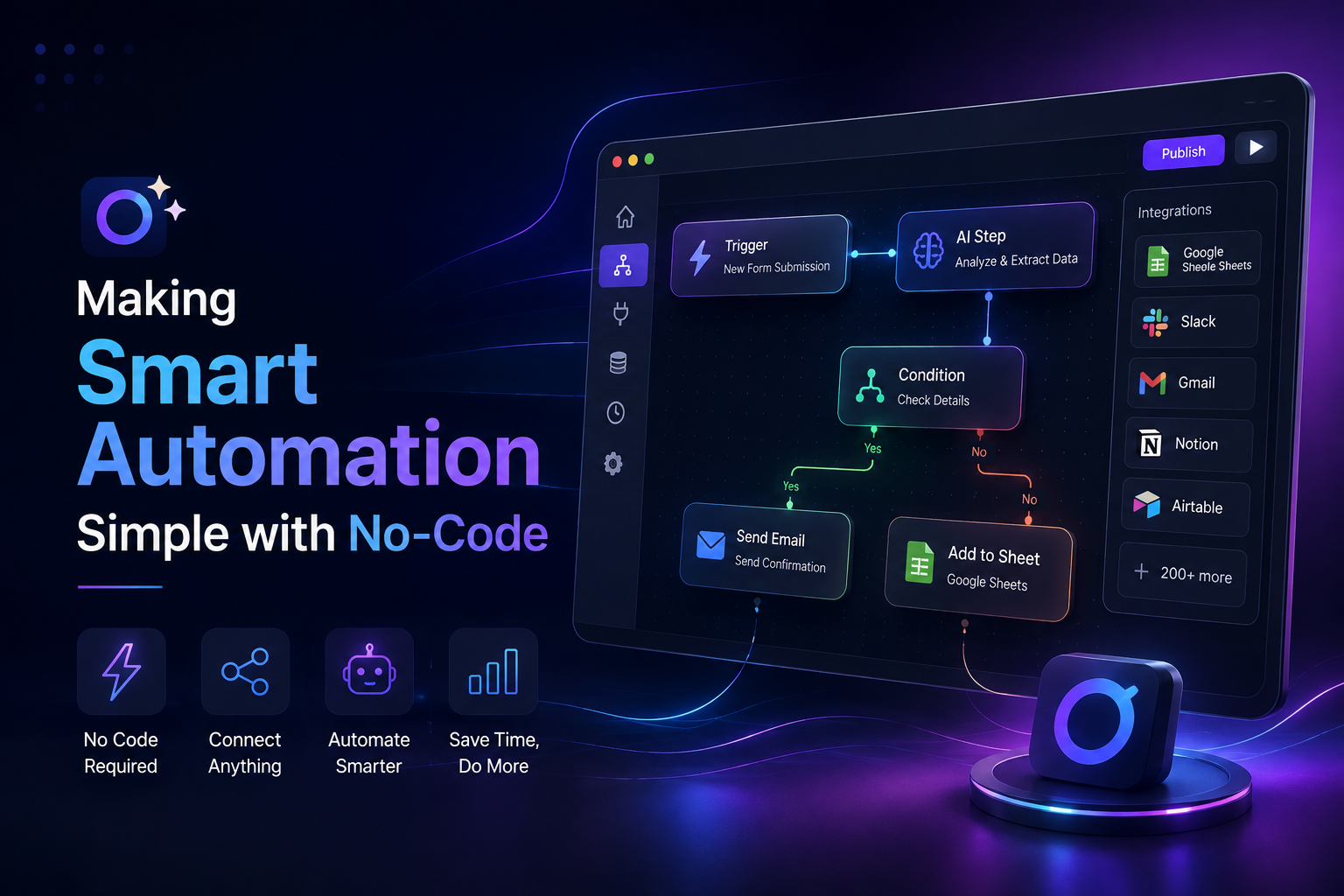
Obviously AI: Making Smart Automation Simple with No-Code
Introduction
Have you ever wished you could harness the power of AI for your business without needing a degree in data science or a team of developers? I know I have! That's exactly where Obviously AI steps in. This platform is changing how businesses, big and small, approach smart automation and predictive analytics. It's designed to make building and deploying AI models incredibly easy for everyone, no coding needed. I find it fascinating how it helps turn complex data into valuable insights quickly, allowing you to make smarter decisions without the usual technical headaches. If you're curious about how AI can be straightforward and accessible, stick around as I explore what makes Obviously AI a standout in the no-code space.

What is Obviously AI and How Does it Work?
Obviously AI is a no-code platform built to help businesses quickly create and use AI models. It's all about making machine learning approachable. I appreciate that it lets you upload your data or connect it from various sources, then guides you through building predictive models in just minutes. The platform emphasizes ease of use and accuracy, which means organizations can automate tasks like forecasting and classification without needing deep technical knowledge.
How does a no-code tool like Obviously AI actually simplify complex machine learning? Obviously AI simplifies complex machine learning by providing a user-friendly interface that abstracts away the underlying code and algorithms. It offers a guided workflow, allowing users to select data, define prediction goals, and generate models with simple clicks. This approach removes the need for programming, making advanced AI accessible.
Can anyone really build an AI model without writing any code? Yes, absolutely! That's the core promise of Obviously AI. It's specifically designed so that anyone, regardless of their coding background, can create AI models. The platform handles all the intricate coding and algorithmic work behind the scenes, leaving you to focus on your data and what you want to predict. This really opens up possibilities for business users who might not have a technical team. If you're interested in understanding more about how different AI tools function, I recommend reading about AI Agents, Automations, and Agentic AI.
Key Benefits of No-Code AI with Obviously AI
Using a no-code AI platform like Obviously AI brings a lot of advantages. From my perspective, the most important benefits are accessibility, speed, and cost-effectiveness. It truly makes artificial intelligence available to a broader audience, allowing individuals without technical skills to create sophisticated models or AI-powered applications through a simple interface. This means tasks that used to take weeks or months can now be finished in minutes, saving valuable time and money.
What makes no-code AI so much faster than traditional methods? No-code AI significantly speeds up the process because it eliminates the need for manual coding, debugging, and infrastructure setup. You can rapidly iterate on models, test hypotheses, and deploy solutions in a fraction of the time it would take with traditional, code-heavy development.
How does skipping the coding part save businesses money? Skipping the coding part saves businesses money by reducing reliance on expensive data scientists and developers. It lowers development costs, accelerates time to market for AI-driven projects, and allows existing teams to implement AI solutions without extensive training or new hires. This means you can achieve powerful results without a huge budget. To learn more about the broader impact of no-code tools, check out this guide on no-code AI tools.
Who Can Use Obviously AI? Practical Applications
Obviously AI is built for a wide range of businesses and individuals who want to use smart automation without needing to hire dedicated data science teams. I've seen it used for everything from predicting customer churn and optimizing marketing spend to forecasting sales and streamlining operations. Its applications are incredibly broad. For example, companies like Cargomatic and TrustedChoice use it to improve their data analytics, showing its value across various industries.
Could a small business owner truly benefit from this tool without a tech team? Absolutely. Small business owners are precisely who can benefit immensely from Obviously AI. Since it requires no coding, they can directly build and deploy AI models to understand their customers better, predict trends, and optimize their operations without the overhead of a technical team. This levels the playing field, making advanced analytics accessible.
What are some common ways businesses are using Obviously AI today? Businesses commonly use Obviously AI for:
- Customer Churn Prediction: Identifying customers likely to leave, allowing for proactive retention strategies.
- Sales Forecasting: Predicting future sales volumes to optimize inventory and resource allocation.
- Marketing Optimization: Understanding which marketing efforts yield the best results to maximize ROI.
- Fraud Detection: Spotting unusual patterns in transactions to prevent financial losses.
- Lead Scoring: Prioritizing sales leads based on their likelihood to convert.
These applications directly translate into better decision-making and improved business outcomes. You can see more examples of how different companies are using no-code AI by exploring what Obviously AI does.

Obviously AI for Predictive Analytics: Real-World Examples
The platform truly shines in predictive analytics, transforming raw data into practical insights. For instance, I've seen users predict which customers are most likely to leave, how marketing efforts will affect future sales, or even forecast traffic to optimize resource planning. The ability to quickly build models for things like churn prediction or sales forecasting gives businesses a powerful advantage in making data-driven decisions.
How accurate are the predictions made by a no-code AI tool? The accuracy of predictions made by a no-code AI tool like Obviously AI can be remarkably high, often comparable to models built by data scientists. The platform uses advanced machine learning algorithms and provides metrics to evaluate model performance, allowing users to understand the reliability of their predictions. The accuracy largely depends on the quality and relevance of the input data.
Can you give an example of how a business might use churn prediction to improve their service? Certainly. Imagine a subscription service company. With churn prediction, they could:
- Identify At-Risk Customers: The AI model flags customers showing early signs of dissatisfaction, like decreased engagement or specific support requests.
- Personalize Interventions: The company then reaches out with tailored offers, improved support, or personalized content to re-engage these customers.
- Improve Service Offerings: By analyzing common factors among churned customers, the company can identify systemic issues and improve their overall service or product features. This proactive approach helps retain valuable customers and enhances customer satisfaction. To dive deeper into the power of predictive AI, I recommend reviewing this Obviously AI review.
Getting Started with Obviously AI: A Simple Approach
Starting with Obviously AI is incredibly straightforward, which is one of its biggest selling points for me. The process typically involves uploading your dataset or connecting it from an existing source. After that, you just follow a guided wizard to build your desired AI model. The platform is designed to be intuitive, letting users quickly select their data, make a few clicks, and generate a working predictive model. This simple approach truly makes AI accessible and practical for tackling everyday business challenges.
What kind of data do I need to get started with Obviously AI? You typically need structured data in formats like CSV, Excel files, or connections to databases and cloud storage. This data should contain historical information relevant to what you want to predict, with clear columns representing features and a target variable for the AI to learn from. For example, if you want to predict customer churn, your data would include customer demographics, usage patterns, and a column indicating whether they churned or not.
Is there a steep learning curve when using a no-code AI tool for the first time? No, there isn't a steep learning curve with Obviously AI. The platform is built with user-friendliness as a top priority, offering a guided experience that minimizes technical jargon and complex configurations. If you can use a spreadsheet, you can likely navigate and build models with Obviously AI. This makes it a great starting point for anyone new to AI.
Follow Owais Abdullah on Google Search & Discover
Add this domain as a preferred source to see new AI engineering, Next.js SaaS, and Digital FTE breakdowns prioritized in your Google Top Stories, AI Overviews, and Discover feed.

Owais Abdullah
Web & AI Engineer · Founder @ Octively
Spec-driven developer and AI engineer. Founder of Octively, building Next.js SaaS platforms, autonomous Digital FTEs (AI employees), and production-ready intelligent workflows.
Recent Posts




Did you find this article helpful?
Questions I get
Frequently Asked Questions
Discussion & Thoughts
Join the conversation with your perspective