

Understanding the Multi-Agent Paradigm in Claude Code
When I first started moving beyond single-agent pair programming, my biggest bottleneck wasn't the AI's intelligence—it was my own ability to manage context. Single-agent setups are great for exploratory tasks, but groomed feature backlogs demand parallel execution. Shifting to multi-agent setups changes your daily role entirely. You stop writing every individual line of code and start shaping specs, managing isolated worktrees, and reviewing distilled outputs. When you build software with smart automation, managing parallel work streams requires clear boundaries.

Why should you use isolated worker sub-agents instead of full agent teams? Isolated worker sub-agents keep context windows clean because each agent only sees its assigned task file rather than the entire repository history. According to Anthropic's Claude Code docs, isolating workers prevents token limits from stalling your builds and keeps latency low. When you run multiple sessions, keeping intermediate tool outputs out of the main prompt window saves money and time.
How do you prevent context window bloat during parallel development? Restricting tool access and instructing workers to return concise summaries prevents token limits from stalling your builds. For a deeper look at how autonomous tools manage state, read our guide on AI agents vs CRUD apps.
Configuring Sub-Agents and Custom Definitions
Custom sub-agents let you store reusable specialist prompts inside your project directory. Each sub-agent runs in an isolated context. It gets only the briefing instructions you provide and returns a short summary of its work. Setting up these definitions correctly is the foundation of any reliable multi-agent architecture.
What tools should you allow for read-only research agents versus execution agents? Read-only research agents need to search files and access web tools, but they require zero write permissions. Execution agents, on the other hand, need targeted file modification access to implement features.
How do you prevent sub-agents from inheriting unwanted permissions? Defining explicit allowlists in agent configuration files blocks unintended shell execution or unauthorized network calls. Here are the core configuration rules I always enforce:
- File search tools assigned exclusively to research roles
- Targeted modification access for builders and execution agents
- Explicit allowlists in configuration frontmatter to block scope creep
- Zero shell permissions for read-only tasks to maintain safety
Implementing Automated Review Gates
Automating validation before code hits disk prevents comprehension debt. By setting up a fail-fast verification pyramid with formatting checks, static analysis, type checking, unit tests, and diff-size guards, you block regressions automatically. When I ran my first multi-agent experiment without review gates, my repository accumulated dozens of subtle type mismatches in minutes.

What happens when an automated quality check fails during a background sub-agent run? Background runs halt immediately and log the exact error output back to the parent orchestrator for targeted fixing. This fail-fast feedback loop ensures broken code never contaminates your main branch.
How can diff-size guards prevent code complexity from overwhelming reviewers? Restricting each sub-agent pull request to under two hundred lines forces modular task breakdown and makes human sign-off straightforward. Here is what my verification pyramid includes:
- Formatting and linter checks run first to catch syntax issues
- Static analysis catches type errors before compilation
- Unit tests verify functional correctness across modules
- Diff-size guards limit maximum pull request scope to keep reviews fast
Orchestrating Parallel Execution and Worktrees
Running parallel workers requires isolated working directories to prevent merge conflicts. By leveraging git worktrees and atomic task tracking, multiple agents can work on separate backlog items concurrently. To master structured specs for these agents, check out our post on spec-driven development. When two agents try to modify the exact same file simultaneously without worktree isolation, git merge failures will grind your workflow to a halt.
How do you handle cross-card dependencies when agents run simultaneously? Sequencing tasks into directed acyclic graphs ensures foundational APIs finish before dependent UI components start.
What strategies help avoid duplicate work across parallel tasks? Assigning strict file ownership boundaries to each worktree prevents two agents from editing the same helper function. Here are the core orchestration practices:
- Git worktrees provide isolated local directories for every parallel agent
- Directed acyclic graphs sequence task dependencies logically
- Strict file ownership boundaries prevent overlap between workers
- Atomic task tracking monitors active progress across all sessions
Reviewing Work and Managing Feedback Loops
Without pull request bottlenecks in trunk-based development, worktree branches are the primary review surface. When a sub-agent completes a task or fails a review gate, structured rejection feedback ensures subsequent iterations pick up right where the fix was needed. I find that treating agent output the same way I treat junior developer code keeps quality consistently high.
How do you spot scope creep in agent-generated pull requests? Comparing the actual file diff against the initial specification highlights unrequested refactoring immediately.
What is the best way to handle agent persistence and handoff states? Storing task state inside structured JSON sidecar files lets parent orchestrators resume failed worker sessions without data loss. Here is how I structure my review loops:
- Worktree branches serve as active review surfaces for every task
- Structured rejection feedback guides repair loops precisely
- Markdown specifications act as drift detectors during review
- JSON sidecar files preserve handoff state across sessions
Avoiding Common Multi-Agent Traps
Multi-agent setups trade reliability for speed, facing challenges like compound failure rates, token consumption spikes, and time blindness. Designing robust harnesses keeps these risks manageable. In my experience, the biggest hidden danger is an agent getting stuck in a retry loop that burns through your entire API credit balance in minutes.
How can you keep API token costs under control when running multiple sessions? Setting strict max-turn limits and caching common context responses prevents runaway API bills during deep background debugging.
What warning signs indicate that an agent is caught in an infinite test loop? Rapid token depletion paired with repeated modification of the exact same test assertion signals a logic deadlock. Here are the essential safety rules I follow:
- Set strict max-turn limits per session to prevent runaway loops
- Cache common context to lower token usage across parallel agents
- Monitor for repeated test assertion edits as a deadlock warning
- Use timeout guards to kill looping agents before costs spike
Summary of the Six Multi-Agent Patterns
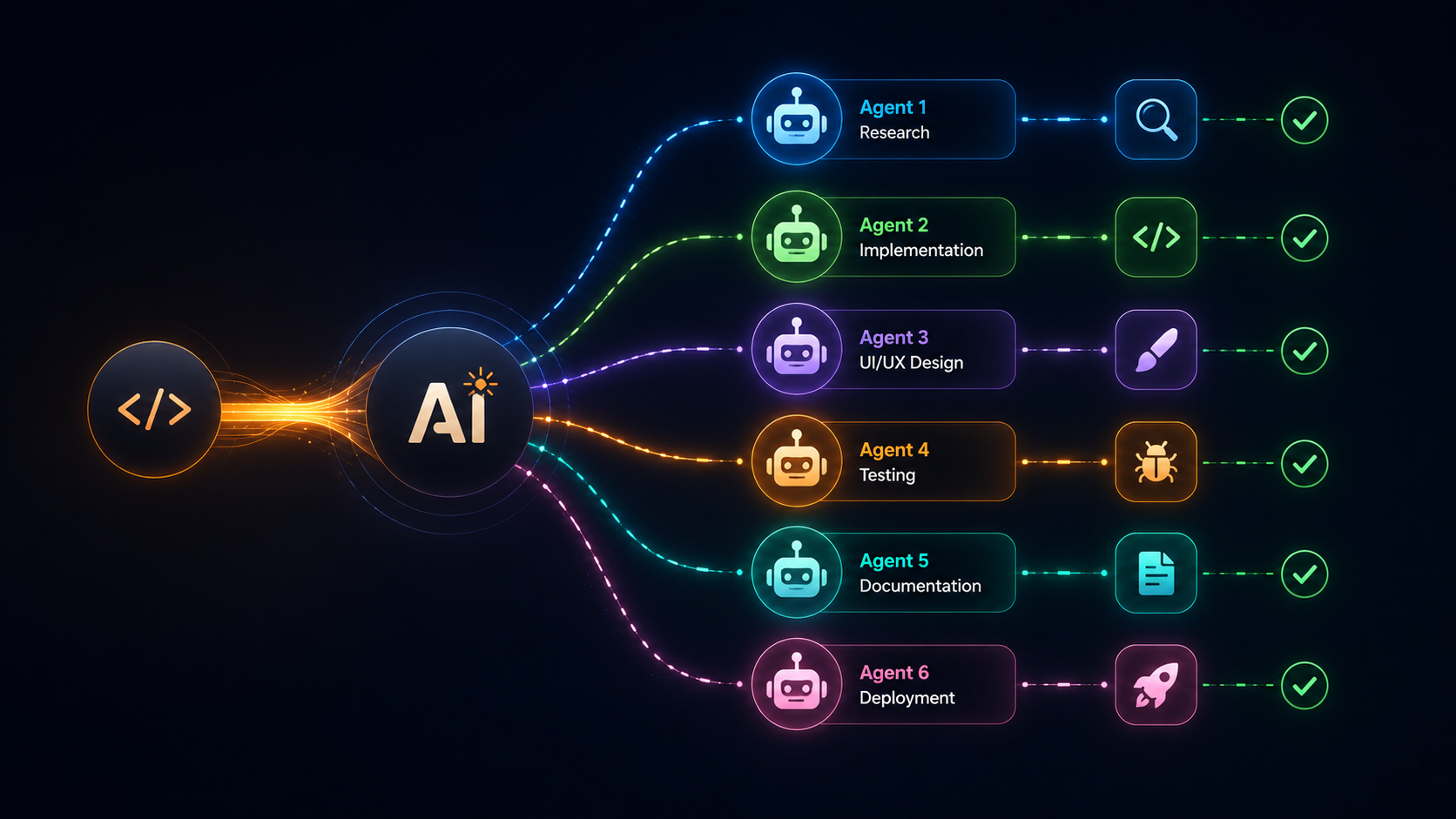
To bring everything together, successful parallel delivery relies on six distinct patterns that transform how you write software. By applying these patterns, you turn autonomous tools into a reliable developer factory. Here are the six patterns:
- Pattern One: Context Boundary Isolation — Assigning single-task scopes to sub-agents to keep token windows clean.
- Pattern Two: Principle of Least Privilege — Restricting tool access with explicit allowlists in agent frontmatter.
- Pattern Three: Fail-Fast Verification Pyramids — Running linters, static checks, and tests automatically before code lands.
- Pattern Four: Git Worktree Isolation — Giving every parallel worker its own local directory to prevent merge conflicts.
- Pattern Five: Specification-Driven Review Loops — Using initial Markdown specs as drift detectors during code review.
- Pattern Six: Harness-Enforced Safety Guards — Setting max-turn limits and timeout guards to prevent infinite loops and token spikes.
Follow Owais Abdullah on Google Search & Discover
Add this domain as a preferred source to see new AI engineering, Next.js SaaS, and Digital FTE breakdowns prioritized in your Google Top Stories, AI Overviews, and Discover feed.
Architecture FAQs
Was this article helpful?
Your feedback helps improve our future articles and tutorials.
Discussion & Thoughts
Join the conversation with your perspective