
GLM-5.3 Review: Testing Z.ai's 743B Model With 200M Tokens
Understanding GLM-5.3 and Its Architecture
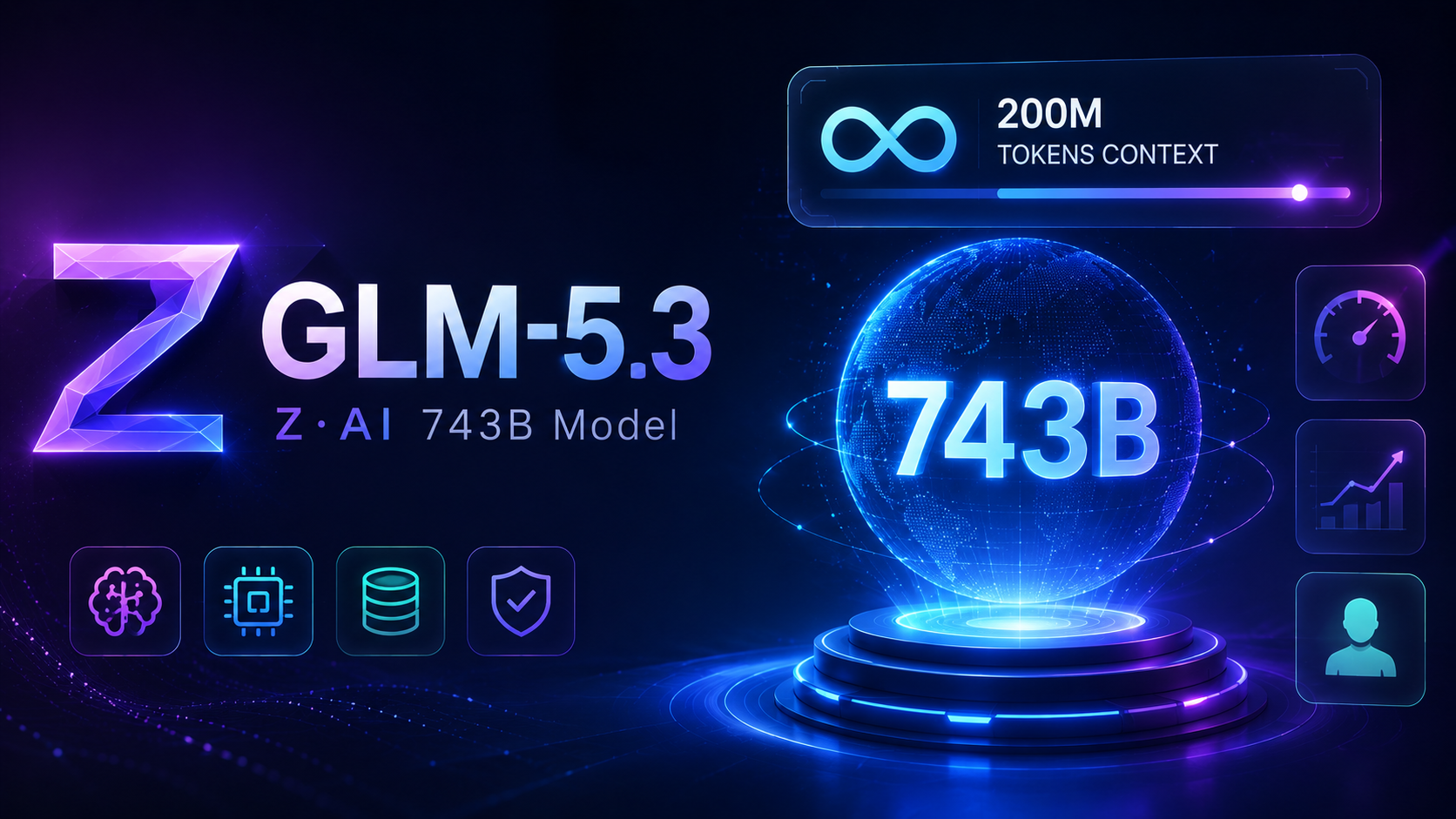
When Z.ai released GLM-5.3, I wanted to see how the open-weight model performs under heavy development pressure. Built on a 743-billion-parameter Mixture-of-Experts base, this version focuses entirely on post-training upgrades using advanced reinforcement learning. After running over 200 million tokens through it in 10 hours of intensive agentic loops, I put its speed, token efficiency, and coding capabilities to the test.
How does reinforcement learning change model output in day-to-day coding? What was your experience with long-context windows?
Z.ai kept the 1-million-token context window from its predecessor, shifting all engineering resources into post-training optimization. By applying advanced reinforcement learning and professional work-unit environments, the model achieves massive gains in multi-step planning without altering its underlying parameter count. For a deeper technical dive, you can explore the Z.ai Official Release Notes or check out the SiliconANGLE Coverage.
Real-World Coding Benchmarks and Long-Horizon Performance
Coding benchmarks tell one story, but multi-day engineering workflows tell another. GLM-5.3 scored an impressive 91.25% on KingBench 3, outpacing several closed frontier models. In daily development, it handles complex 3D Three.js rendering and local fine-tuning with remarkable consistency.

How do you manage multi-step coding tasks with AI agents? Have you noticed improvements in agent autonomy?
You can read independent evaluations on the AIToolsReview Insights or review the AI Release Tracker. If you are exploring how advanced models fit into modern developer workflows, you might also want to read more about AI Agents, Automations, and Agentic AI - What’s Really Different?.
Emergent Cybersecurity and Automated Vulnerability Auditing
One of the most surprising findings with GLM-5.3 is its sudden leap in security auditing. Scoring 84.5% on CyberGym, the model autonomously flagged thousands of vulnerabilities across public repositories. While this opens up powerful defensive capabilities, it also raises important questions about dual-use safety.

How are you preparing your applications for AI-driven security audits? What safeguards do you use?
More details on these security audits can be found in the MindStudio Analysis. When comparing how different frontier models handle complex tasks, it is also helpful to review Is Riftrunner Google's Worst Gemini 3.0 Checkpoint Yet? My Full Test Results.
Token Economics and Pricing Plans for Developers
Running 200 million tokens requires careful budget management. Z.ai offers tiered subscription plans ranging from Lite ($18/mo) to Max ($160/mo), alongside flexible API access. For teams building heavy agentic workflows, understanding these rate limits and token costs is essential for sustainable development.
What is your monthly token budget for AI development? Do subscription tiers fit your workflow better than pay-as-you-go APIs?
Compare these plans directly on the Z.ai Pricing Portal.
Final Verdict on GLM-5.3
GLM-5.3 proves that post-training reinforcement learning can unlock massive performance gains without scaling parameters. For creators and developers looking for a powerful open-weights model with a 1-million-token window, it is a formidable tool for daily engineering.
Will you be integrating GLM-5.3 into your next stack? Let’s build something great.
Follow Owais Abdullah on Google Search & Discover
Add this domain as a preferred source to see new AI engineering, Next.js SaaS, and Digital FTE breakdowns prioritized in your Google Top Stories, AI Overviews, and Discover feed.

Owais Abdullah
Web & AI Engineer · Founder @ Octively
Spec-driven developer and AI engineer. Founder of Octively, building Next.js SaaS platforms, autonomous Digital FTEs (AI employees), and production-ready intelligent workflows.
Recent Posts

Context Memory Systems for Multi Agent AI Workflows: Architecture & Best Practices
Sep 27, 2026
AI Agent Over-Engineering: Simple Workflows vs 30-Agent Architectures
Sep 26, 2026
Stop AI Agent Overengineering and Use Simple Workflows
Sep 25, 2026
Jev System One Model: Cut AI Classifier Latency and Costs
Sep 24, 2026
Did you find this article helpful?
Questions I get
Frequently Asked Questions
Discussion & Thoughts
Join the conversation with your perspective