

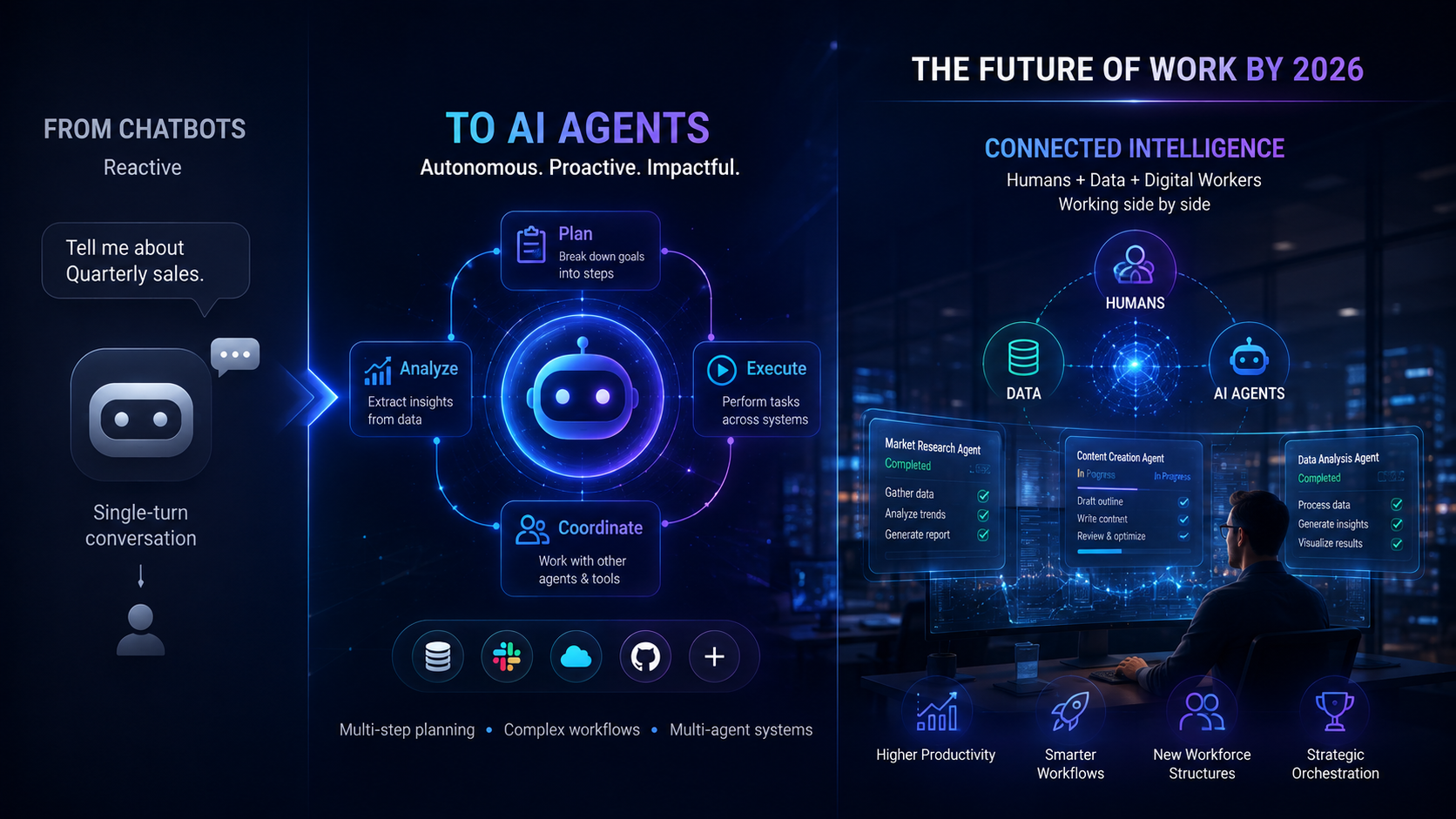
From Chatbots to Digital Coworkers: How AI Agents Will Transform Work by 2026
The Shift From Prompts to Autonomous Systems
The way we work is undergoing a major shift. For years, we relied on reactive chatbots that sat quietly in a sidebar, waiting for a prompt before spitting out a block of text. Today, smart automation has evolved into autonomous agents capable of managing multi-step workflows, executing code, and coordinating tasks across apps. Instead of treating software as a passive tool, modern teams are collaborating with digital coworkers that handle complex, long-horizon tasks.

Traditional chat tools require constant human input for every single step. In contrast, autonomous agents operate with a clear goal in mind, breaking down complex objectives into sequential steps and executing them across databases, APIs, and file systems. This shift moves us from manual trial-and-error to high-level system supervision. For a deeper look into how enterprise apps are evolving, check out Cisco's Workplace Predictions.
What repetitive tasks on your desk could benefit from an agent that plans and executes independently? How does your team currently handle multi-step workflows that require cross-application data sharing?
Meet Your New Digital Teammates Across Departments
Smart automation is no longer just for software engineers. Non-technical departments like finance, legal, and marketing are increasingly relying on specialized agents to handle data consolidation, draft reports, and streamline daily operations. As highlighted in research on Agentic AI Transformation, modern workers are spending less time on manual formatting and more time acting as strategic orchestrators.
Which department in your organization spends the most hours on routine reporting? What would your team achieve if administrative bottlenecks were handled automatically?
Scaling Long-Horizon Tasks With Parallel Agents
One of the most exciting developments in modern automation is the ability to run tasks that take minutes or even hours without human intervention. Instead of waiting for a single response, creators and professionals can orchestrate parallel agent tasks to handle research, data analysis, and drafting simultaneously.

Insights from OpenAI's Research on Agent Workflows demonstrate that professionals across all sectors now rely on long-context agents for over 80 percent of their output tasks. How could your workflow improve if you could delegate multi-hour research projects while you focus on creative strategy? What safeguards do you have in place when running unattended agent processes?
Navigating Security Data Readiness and Trust
Giving software the autonomy to execute actions requires a solid foundation of data readiness and robust security controls. Without clean cloud-based data and strict identity permissions, automation can quickly become unmanageable or insecure. Modern organizations must prioritize structured data storage and clear governance before deploying autonomous agents at scale.
How is your data currently stored, and is it ready for automated indexing? What steps are you taking to ensure that automated tools respect your privacy and security boundaries?
Redefining Productivity and the Future of Work
The ultimate goal of digital coworkers is not to replace human creativity, but to amplify it. By taking over repetitive administrative chores, smart automation allows creators and founders to focus on leadership, problem-solving, and high-level strategy. This collaborative model turns every professional into a manager of their own digital workforce.
How do you plan to adjust your skill set as routine tasks become fully automated? What new creative projects would you prioritize if administrative overhead were cut in half?
Follow Owais Abdullah on Google Search & Discover
Add this domain as a preferred source to see new AI engineering, Next.js SaaS, and Digital FTE breakdowns prioritized in your Google Top Stories, AI Overviews, and Discover feed.

Owais Abdullah
Web & AI Engineer · Founder @ Octively
Spec-driven developer and AI engineer. Founder of Octively, building Next.js SaaS platforms, autonomous Digital FTEs (AI employees), and production-ready intelligent workflows.
Recent Posts

OpenAI Agents SDK vs Claude Code: Which Framework Fits Your Stack
Sep 17, 2026
Jev System One: 100ms Structured Decisions for Browser Automation
Sep 17, 2026
What Is a Digital FTE? How Local AI Employees Run Your Business 24/7
Sep 15, 2026
Gun.io vs Revelo vs Independent Devs Which Hiring Path Wins
Sep 13, 2026
Did you find this article helpful?
Questions I get
Frequently Asked Questions
Discussion & Thoughts
Join the conversation with your perspective