

AI Agents vs CRUD Apps: When Do You Need Autonomous Workflows
Understanding Traditional CRUD Architecture
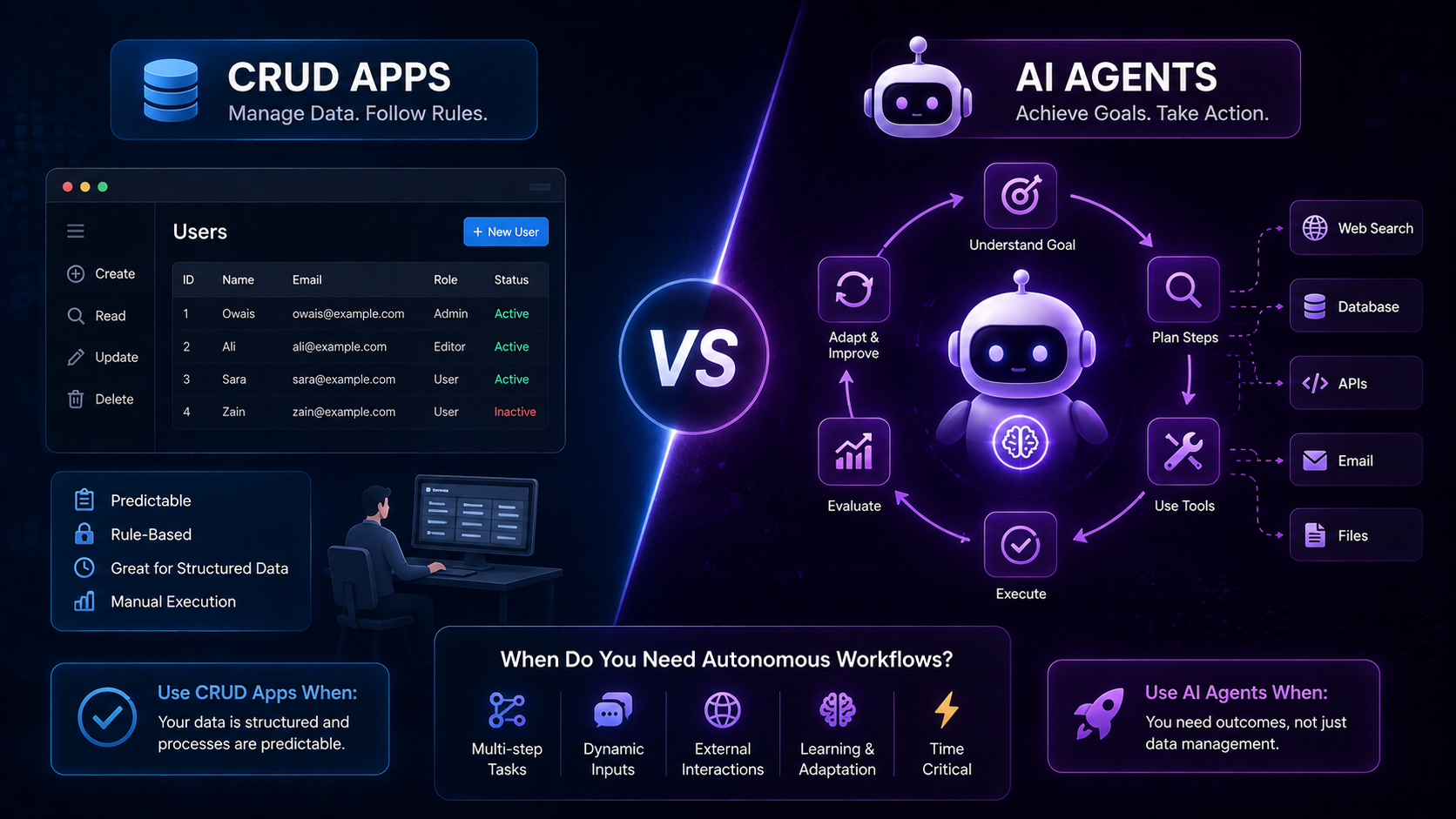
Traditional database-backed applications power the modern web through predictable, structured databases and deterministic rules. Every database query, API route, and state transition operates according to rigid, deterministic logic. This predictable structure guarantees high performance, complete auditability, and minimal compute overhead for stable business data.

When your team builds core data layers, you need a reliable foundation. A deterministic setup ensures that your database transactions execute with zero ambiguity and absolute speed.
The Rise of Autonomous AI Workflows
Autonomous workflows introduce large language models and reasoning loops to handle unstructured inputs, dynamic queries, and complex decision-making. Instead of following fixed scripts, these agents plan multi-step actions, utilize external tools, and adapt when encountering unexpected variables. They shine in scenarios requiring human-like judgment, such as customer support triage or automated document parsing.
When you face messy data inputs or complex multi-step tasks, traditional scripts fall short. Autonomous agents step in to bridge that gap by processing unstructured info and deciding the next step on their own.
Comparing Deterministic Systems with Agentic Loops
Evaluating architectural trade-offs requires looking at how each system handles variability and failure. Traditional CRUD apps break down when presented with messy, unstructured data because they cannot improvise outside predefined code paths. AI agents handle variability gracefully, but they introduce probabilistic outputs, higher latency, and increased operational costs.

Here is how both approaches compare across key system attributes:
- Predictability: Traditional CRUD apps offer 100% deterministic outputs, while AI agents produce probabilistic results requiring oversight.
- Data Handling: Traditional databases require strict schemas, whereas agents easily parse unstructured text, PDFs, and conversational inputs.
- Execution Cost: Database queries run with minimal compute overhead, while agent reasoning loops incur higher token costs and latency.
- Error Recovery: CRUD scripts fail immediately on unexpected inputs, while autonomous agents re-plan and attempt corrective actions.
You can learn more about how modern teams structure these tools by exploring AI Agents vs Workflow Automation.
Building Effective Hybrid Architectures
Modern software design rarely requires an absolute choice between traditional code and autonomous agents. The most resilient systems combine both by using traditional CRUD databases for secure, reliable data persistence while deploying AI agents as an outer orchestration layer. This hybrid model keeps sensitive data secure while leveraging smart automation for complex user interactions.
How can your engineering team design clean interfaces between static databases and dynamic agents? You want to establish clear boundaries where your database handles core records and your agents manage intelligent routing.
According to industry research on AI Agents vs Traditional Automation, combining deterministic data layers with adaptable reasoning loops gives teams the best of both worlds without risking data integrity.
Follow Owais Abdullah on Google Search & Discover
Add this domain as a preferred source to see new AI engineering, Next.js SaaS, and Digital FTE breakdowns prioritized in your Google Top Stories, AI Overviews, and Discover feed.

Owais Abdullah
Web & AI Engineer · Founder @ Octively
Spec-driven developer and AI engineer. Founder of Octively, building Next.js SaaS platforms, autonomous Digital FTEs (AI employees), and production-ready intelligent workflows.
Recent Posts

Pick Your First AI Automation Project Without Framework Paralysis
Oct 4, 2026
Context Memory Systems for Multi Agent AI Workflows: Architecture & Best Practices
Sep 27, 2026
AI Agent Over-Engineering: Simple Workflows vs 30-Agent Architectures
Sep 26, 2026
Stop AI Agent Overengineering and Use Simple Workflows
Sep 25, 2026
Did you find this article helpful?
Questions I get
Frequently Asked Questions
Discussion & Thoughts
Join the conversation with your perspective