


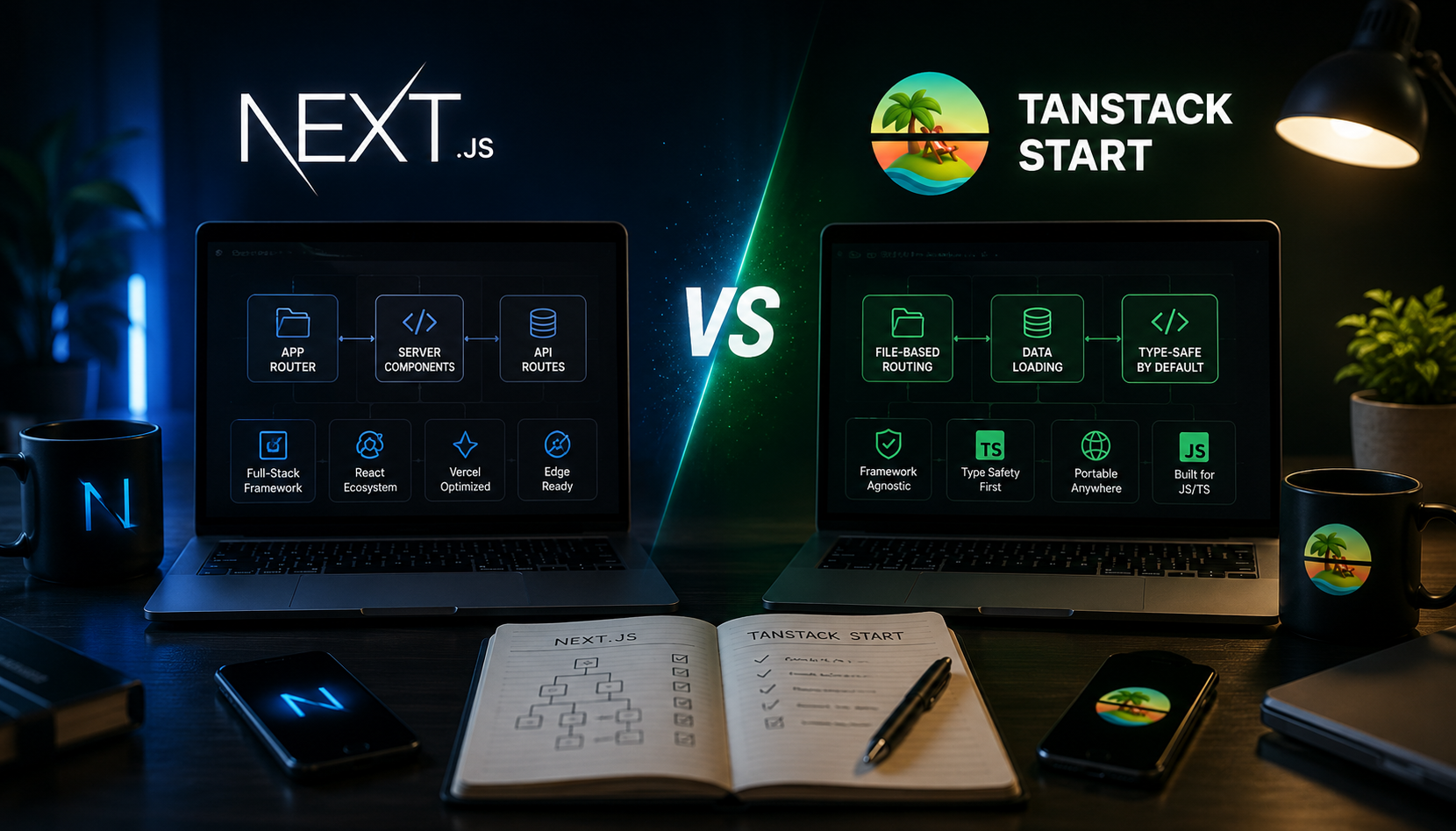
When I help clients pick a tech stack for a new web app, the debate usually comes down to two choices: Next.js or TanStack Start. You want a foundation that speeds up your team without locking you into proprietary infrastructure. Let's look at how these two frameworks compare so you can choose the right stack for your next project.
Architectural Philosophies and the Mental Model Gap
The core difference between Next.js and TanStack Start starts with where code runs and how default behaviors are structured. Next.js embraces an integrated, server-first paradigm where components are React Server Components by default, requiring you to opt out with use client. Conversely, TanStack Start takes an additive, client-first approach, treating server capabilities and streaming as progressive enhancements rather than rigid requirements.

What foundational trade-offs separate an RSC-first framework from an additive router architecture? Next.js forces your team into server-driven rendering from the first line. This works great for static or read-heavy pages, but it adds friction when you manage complex client-side state. TanStack Start lets you build standard client-side components freely and add server functions only where needed, giving you granular control over the rendering pipeline without fighting default rules.
How does the default mental model influence day-to-day component building and state management? With Next.js, you constantly think about server boundaries, serialization, and client directive placement. With TanStack Start, the boundaries are explicit and driven by route loaders and server functions, keeping state management familiar to anyone who has used React Query and Vite.
Routing and End-to-End Type Safety
File-based routing is standard for both frameworks, but the depth of type safety creates a stark contrast during daily development. Next.js provides folder conventions with optional typed route helpers, whereas TanStack Start, powered by TanStack Router, delivers compile-time type inference for path parameters, search parameters, and loader data.
Why does compile-time route verification prevent costly production bugs? Runtime errors from misspelled route parameters or mismatched search queries vanish when your router checks types before compilation even finishes. This means refactoring a URL parameter across ten different files takes seconds instead of requiring manual audits.
How do typed search parameters transform how client-side state is handled in modern web apps? Instead of casting strings from URL search parameters manually, TanStack Start parses and types them automatically. Your filters, pagination states, and tab selections stay fully type-safe and shareable via URL without boilerplates. You can explore official architecture insights directly in the TanStack Start Documentation.
Data Fetching and Caching Strategies
Data fetching workflows dictate how efficiently your application handles network requests and state hydration. Next.js relies on direct async server component queries paired with framework-managed caching layers like revalidatePath. TanStack Start combines isomorphic route loaders with TanStack Query, offering SWR-style caching, background refetching, and robust state synchronization.
When should you choose framework-managed server caching over client-driven query caching? Framework-managed caching shines when pages render entirely on the server and rarely change, reducing database load. Client-driven query caching wins when building dashboards or collaborative tools where background updates, optimistic mutations, and instant UI feedback matter most.
How do isomorphic loaders simplify SSR hydration across different deployment targets? By running data loading logic on both server and client without code duplication, isomorphic loaders ensure your initial HTML payload matches client hydration state cleanly across any Node or serverless runtime. For a deeper technical comparison on data fetching layers, read this MakerKit SaaS Guide.
Server Functions and Client-Server Boundaries
Bridging the client-server gap without writing separate API routes is essential for developer velocity. Next.js utilizes Server Actions and Route Handlers within its App Router convention. TanStack Start provides typed server functions featuring composable middleware chains where input validation and context flow seamlessly into handlers.
What makes typed server functions superior to loose request payloads? Typed server functions enforce end-to-end type safety between your frontend call and backend execution. If you change a database model field, your client invocation instantly flags a type error before deployment.
How do action middleware patterns keep your authentication and authorization rules clean? Composable middleware lets you wrap server functions with auth checks, rate limiters, and validation schemas cleanly, avoiding repetitive boilerplate checks inside every single action handler.
Build Speed and Deployment Portability
Infrastructure lock-in and iteration speed heavily influence long-term operational costs. Next.js is heavily optimized for Vercel's edge network, while TanStack Start leverages Vite and Nitro to produce self-contained server bundles deployable to Node, Cloudflare, AWS, or any standard host without proprietary friction.
How does Vite's ESM architecture improve developer iteration speed over traditional bundlers? Vite serves source files over native ESM during development, resulting in near-instantaneous cold starts and hot module replacement that never bogs down as your application codebase expands.
What are the operational benefits of choosing a host-agnostic deployment target? Host-agnostic deployment gives you total freedom to migrate your infrastructure whenever pricing or performance needs shift, eliminating platform lock-in risks. You can review architectural benchmarks in this LogRocket Framework Comparison.
The Final Verdict for Your Next App
Choosing between Next.js and TanStack Start depends entirely on your infrastructure preferences and team background. If you want deep Vercel ecosystem integration and server components by default, Next.js remains a proven choice. If you prefer uncompromised type safety, Vite-powered iteration speed, and host-agnostic deployment flexibility, TanStack Start delivers an exceptional developer experience.
Follow Owais Abdullah on Google Search & Discover
Add this domain as a preferred source to see new AI engineering, Next.js SaaS, and Digital FTE breakdowns prioritized in your Google Top Stories, AI Overviews, and Discover feed.
Architecture FAQs
Was this article helpful?
Your feedback helps improve our future articles and tutorials.
Discussion & Thoughts
Join the conversation with your perspective