



Smart AI development doesn't need to break the bank or sacrifice performance. When DeepSeek introduced the V4.1 Flash model, it quietly shifted expectations for what an efficient, cost-effective language model can achieve. By combining a unique asymmetric mixture of experts design with native visual understanding and ultra-low API costs, this model delivers flagship-level capability without the heavy price tag. Let's break down how its architecture works, what benchmarks reveal, and how developers and creators can make the most of it.
Are you looking for ways to run advanced agentic tasks without huge token bills? Have you wondered how modern AI models handle high-throughput workloads efficiently?
Decoding the Asymmetric Mixture of Experts Design
The core strength of DeepSeek V4.1 Flash lies in its unique parameter distribution. Rather than treating every token with the same computational weight, the model features a 552 billion parameter backbone paired with 196 billion parameters in its engram memory modules. During active processing, it activates roughly 8 billion parameters for input and 16 billion for output.
This smart allocation is powered by a causal encoder-decoder design where most input tokens skip full decoder computations. For coding agents and developers reviewing long conversation histories or multi-file repositories, this setup cuts unnecessary overhead right from the start.
How does skipping decoder computations speed up your development workflow? What makes asymmetric scaling ideal for resource-conscious projects?
Read more about these foundational breakthroughs in the DeepSeek Official Technical Report.
KV Cache Optimizations and Serving Cost Reductions
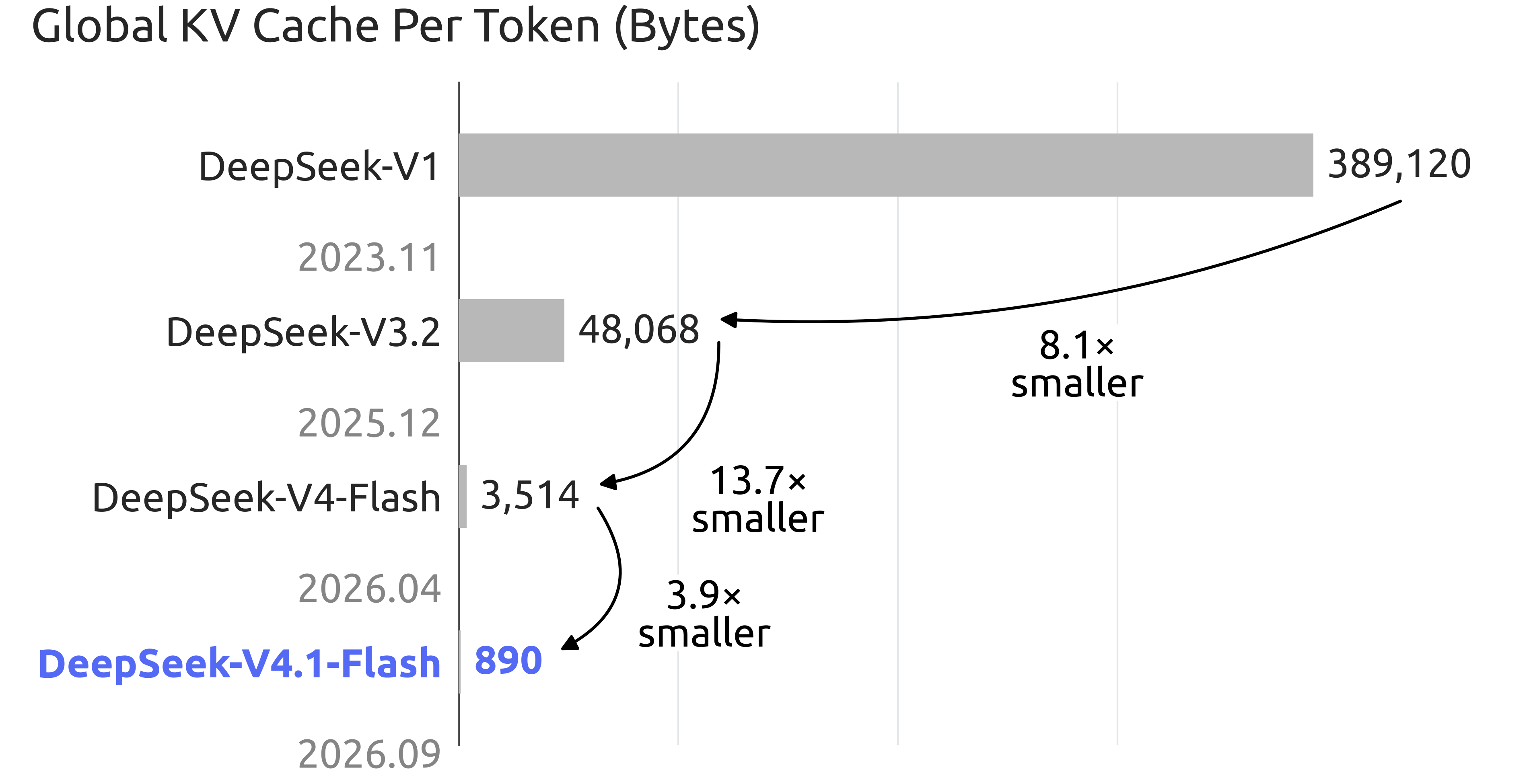
Maintaining massive context windows usually demands expensive high-bandwidth memory to store the persistent KV cache. DeepSeek tackled this bottleneck head-on, reducing global KV cache requirements to just 890 bytes per token. This represents a massive reduction compared to earlier generations, requiring a fraction of the GPU memory and SSD storage.
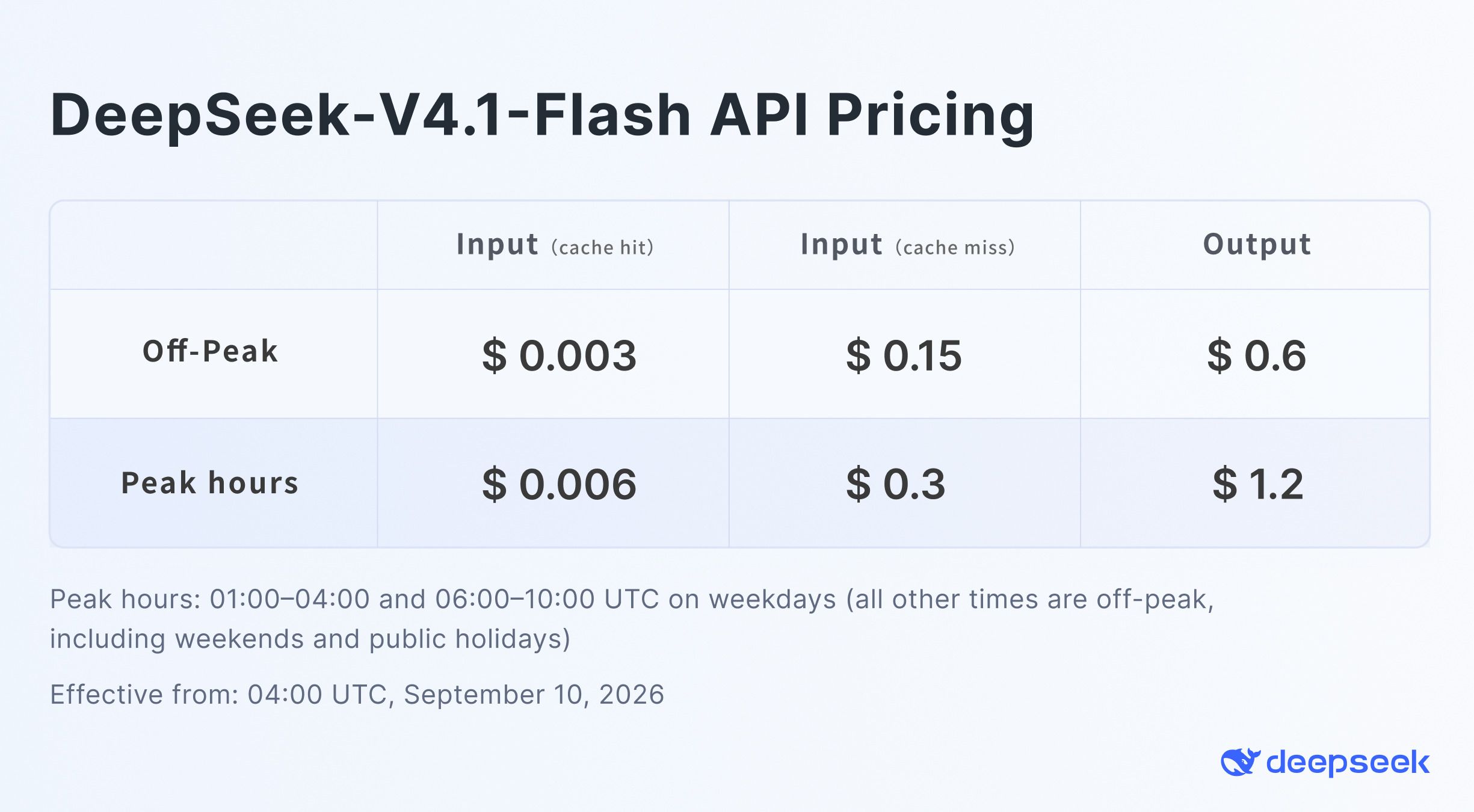
These hardware-level efficiencies directly translate to developer-friendly pricing. Off-peak cached input tokens cost a mere $0.003 per million, while uncashed input sits at $0.15 and output tokens at $0.60 per million.
How do low serving costs change how you build and test AI agents? Can cache-heavy workflows save your team significant overhead?
Explore live inference options and rates on OpenRouter DeepSeek V4.1 Flash Inference.
Evaluating Benchmark Performance Across Coding and Reasoning
Performance metrics tell a compelling story when looking at V4.1 Flash. On evaluation harnesses like KingBench 3 with maximum reasoning effort enabled, the model scores 81.25%, rivaling flagship models while maintaining impressive speeds ranging from 138 to over 220 tokens per second including reasoning traces.
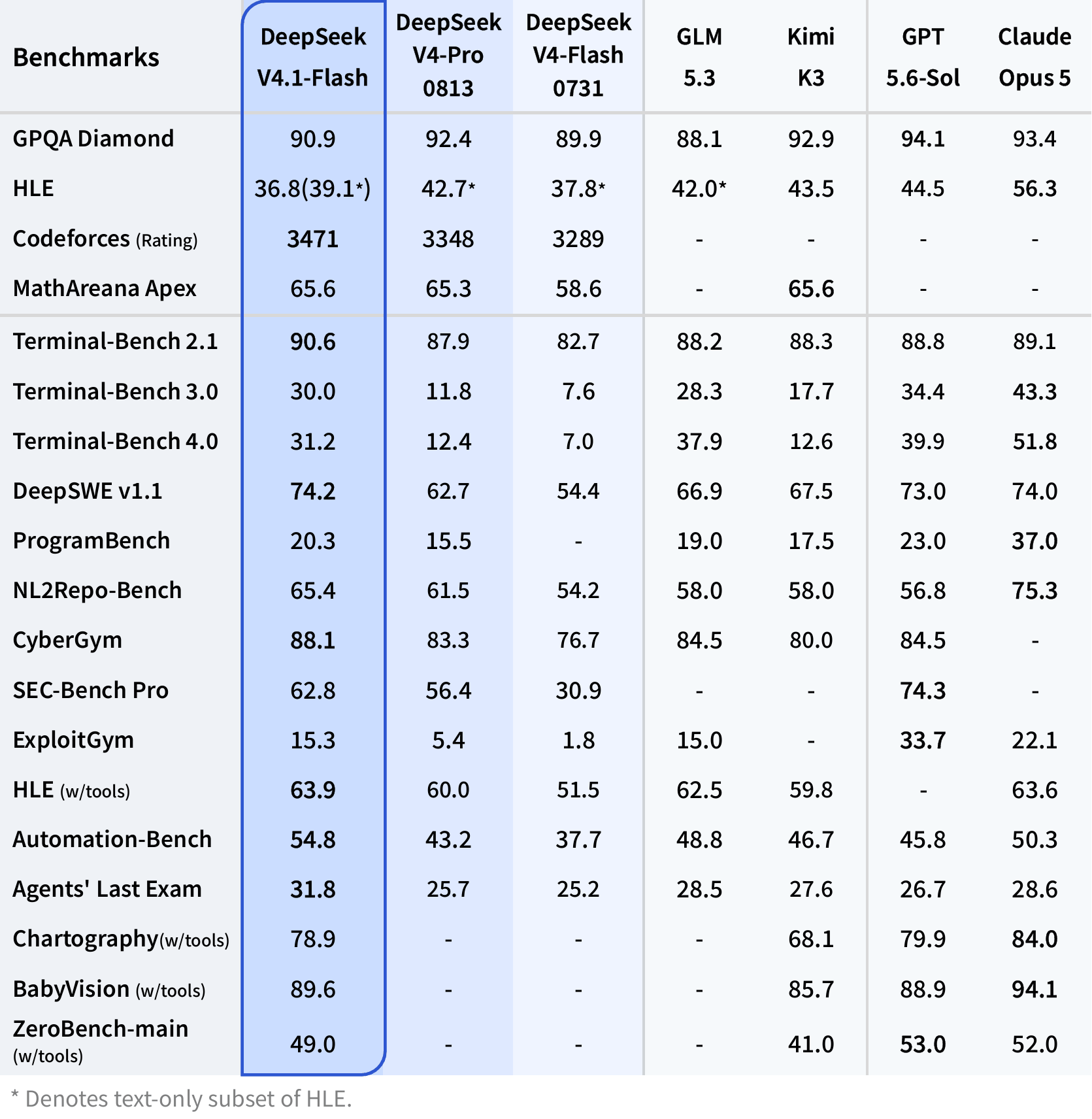
Terminal Bench and cybersecurity evaluations confirm that post-training reinforcement learning generalizations hold strong across newer task versions. Whether you are building interactive web simulations or local fine-tuning workflows, the output quality remains sharp.
Where do you notice the biggest performance gains in your day-to-day coding tasks? How does maximum reasoning effort impact your final output accuracy?
Review open-source implementation details on the DeepSeek GitHub Organization.
Integrating V4.1 Flash Into Modern Developer Harnesses
Transitioning to the new model is straightforward for teams currently relying on earlier DeepSeek checkpoints. Since standard API endpoints automatically route legacy Pro requests to V4.1 Flash, developers instantly benefit from lower costs and faster throughput.
When paired with modern agentic development environments like Command Code, the model handles complex design adjustments, local fine-tuning setups, and multi-file debugging seamlessly.
What development harness do you currently use for your AI projects? Are you ready to upgrade your automation pipeline with faster, lighter models?
Learn more about managing your repositories and agent tools at the DeepSeek GitHub Organization.
Future-Proofing Your AI Workflows With Cost-Efficient Models
As AI capabilities expand, balancing cost against performance is essential for sustainable growth. DeepSeek V4.1 Flash demonstrates that high throughput and advanced reasoning don't have to require enterprise-level budgets. By adopting efficient memory handling and smart caching strategies, creators and small business owners can build powerful solutions without overcomplicating their technology stack.
What steps can you take today to optimize your AI tool stack? How will lower token pricing influence your upcoming app releases?
Discover community-driven deployment options via OpenRouter DeepSeek V4.1 Flash Inference.
Follow Owais Abdullah on Google Search & Discover
Add this domain as a preferred source to see new AI engineering, Next.js SaaS, and Digital FTE breakdowns prioritized in your Google Top Stories, AI Overviews, and Discover feed.
Architecture FAQs
Was this article helpful?
Your feedback helps improve our future articles and tutorials.
Discussion & Thoughts
Join the conversation with your perspective