

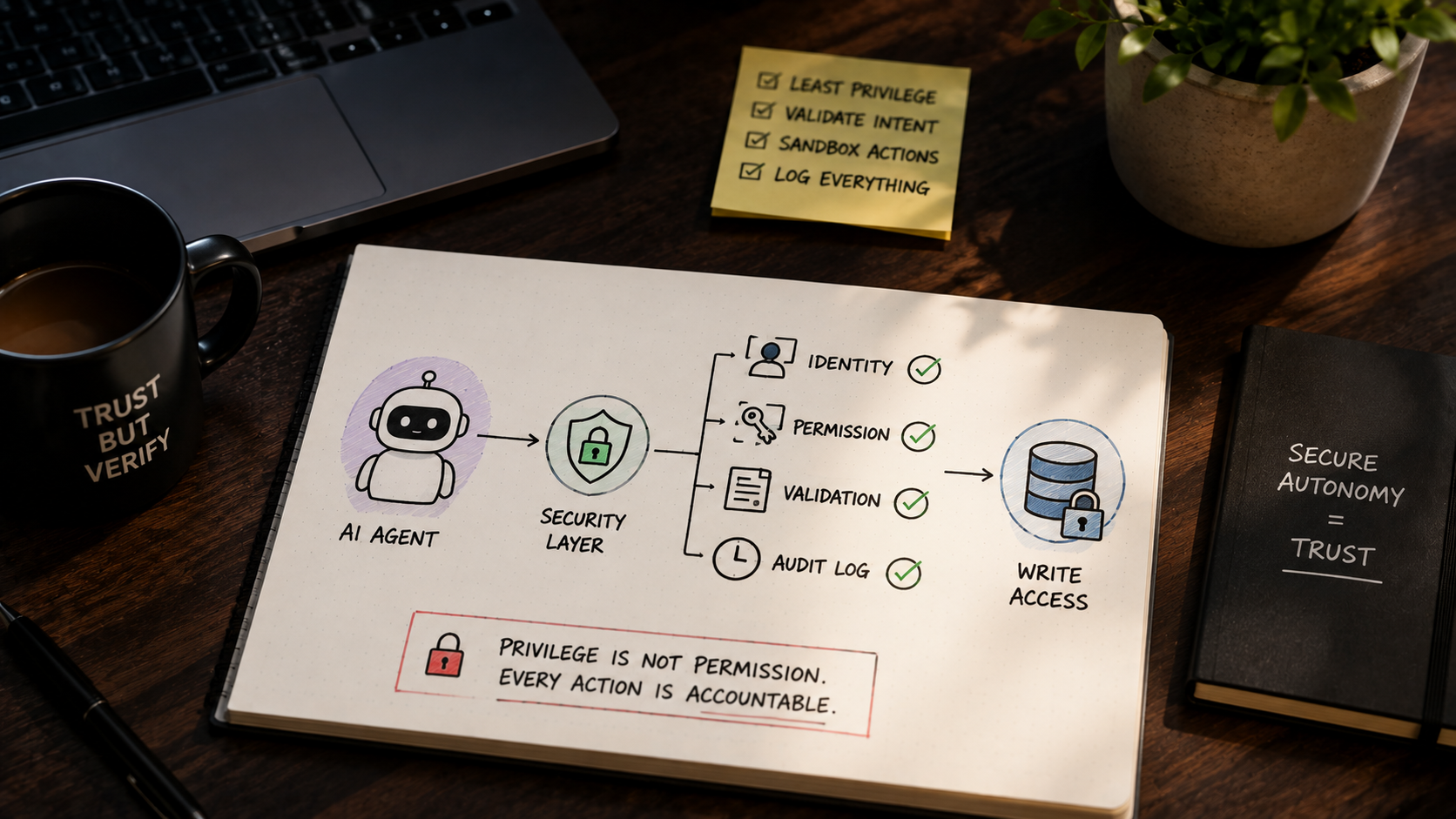
AI Agent Write Access Security: Best Practices for Safe Production Control
Introduction
Moving AI agents from passive observers to active system participants changes how engineering teams approach software security. When automated tools gain write access across cloud dashboards, databases, and CI/CD pipelines, traditional security setups built for human speed quickly break down. Because autonomous workflows operate continuously and make rapid decisions, granting real system control requires careful planning. If you are building automated systems, you need dynamic identity management and strict runtime controls to keep production stable.
Moving Beyond Static Roles and Broad Service Accounts
Traditional infrastructure relies heavily on broad API keys and long-lived service accounts that mimic human admin logins. For autonomous agents, this over-permissioning creates severe vulnerabilities. When an agent can read, write, and delete records across multiple SaaS apps at the same time, a single misinterpretation or prompt injection can trigger widespread data corruption.

Moving to true system control means treating every agent as a dedicated digital identity with strictly scoped capabilities. Rather than handing out blanket tokens, platform architects must enforce non-human identity governance where credentials are short-lived and tied directly to specific operational parameters.
- Risk of Broad Keys: Long-lived API tokens create single points of failure if compromised.
- Dedicated Digital Identities: Every agent gets a unique credential tied only to its assigned task.
- Short-Lived Tokens: Credentials expire automatically after the workflow finishes.
Enforcing Least Privilege Through Runtime Guardrails
Static permissions are rarely enough when dealing with probabilistic software. An agent that needs write access to update a customer support ticket should never possess broad administrative rights over underlying database tables. Implementing the principle of least privilege requires wrapping agent tool calls in dynamic proxy layers that evaluate context in real time.
These runtime guardrails inspect every proposed action before execution. If an agent attempts an unauthorized modification or encounters an anomalous loop, policy-as-code engines can intercept the request, downgrade privileges, or require human sign-off before any damage occurs. You can learn more about how automated workflows operate by reading this guide on AI Agents, Automations, and Agentic AI.
- Dynamic Proxy Layers: Intercept and inspect tool calls before they reach production databases.
- Policy-as-Code: Automate permission checks based on runtime context rather than static tables.
- Human-in-the-Loop: Trigger mandatory reviews when high-risk modifications are requested.
Isolating Execution Environments and Preventing Rogue Loops
Even with strict authorization policies, autonomous agents can occasionally generate unexpected execution paths. To prevent a rogue agent from modifying production databases or altering infrastructure configurations, isolation becomes mandatory. Containerized sandboxes and hardware-assisted virtualization provide secure boundaries that contain any accidental cascade.
By pairing sandboxed execution environments with explicit tool scoping, engineers can ensure that if an agent goes off track, its blast radius remains strictly localized. This architecture turns potential catastrophic failures into manageable, isolated exceptions.
- Containerized sandboxes: Run agent workflows in isolated environments away from core systems.
- Explicit Tool Scoping: Limit available functions to only what is necessary for the current task.
- Localized Blast Radius: Ensure unexpected loops only impact non-critical test spaces.
Establishing Continuous Monitoring and Rapid Containment
When systems operate at machine speed, reactive security models fall short. Teams need complete visibility into every API call, tool invocation, and data modification executed by their agents. Continuous monitoring platforms map agent behavior against established baselines to spot anomalies instantly.

Crucially, monitoring must be paired with immediate containment options. Administrators need the ability to throttle, quarantine, or revoke agent tools with a single click—ensuring that safety protocols can be enforced without requiring emergency code deployments. You can also explore how new AI models perform under stress in our review on Google's Gemini 3.0 Checkpoint.
- Real-Time Visibility: Track every API call and tool invocation as it happens.
- Anomaly Detection: Flag unusual execution patterns before data loss occurs.
- Instant Kill Switches: Revoke compromised tool access immediately without a full redeploy.
Follow Owais Abdullah on Google Search & Discover
Add this domain as a preferred source to see new AI engineering, Next.js SaaS, and Digital FTE breakdowns prioritized in your Google Top Stories, AI Overviews, and Discover feed.

Owais Abdullah
Web & AI Engineer · Founder @ Octively
Spec-driven developer and AI engineer. Founder of Octively, building Next.js SaaS platforms, autonomous Digital FTEs (AI employees), and production-ready intelligent workflows.
Recent Posts

Pick Your First AI Automation Project Without Framework Paralysis
Oct 4, 2026
Context Memory Systems for Multi Agent AI Workflows: Architecture & Best Practices
Sep 27, 2026
AI Agent Over-Engineering: Simple Workflows vs 30-Agent Architectures
Sep 26, 2026
Stop AI Agent Overengineering and Use Simple Workflows
Sep 25, 2026
Did you find this article helpful?
Questions I get
Frequently Asked Questions
Discussion & Thoughts
Join the conversation with your perspective